

- QUASAR
- AquaCycle
- Proteins4Singapore
- Singapore's Pathway to Carbon Neutrality
- CellFACE
- LightSPAN
- Computational Modelling Group
- Energy and Power Systems Group
- SITEM - Singapore Integrated Transport and Energy Model
- Past Projects
Events
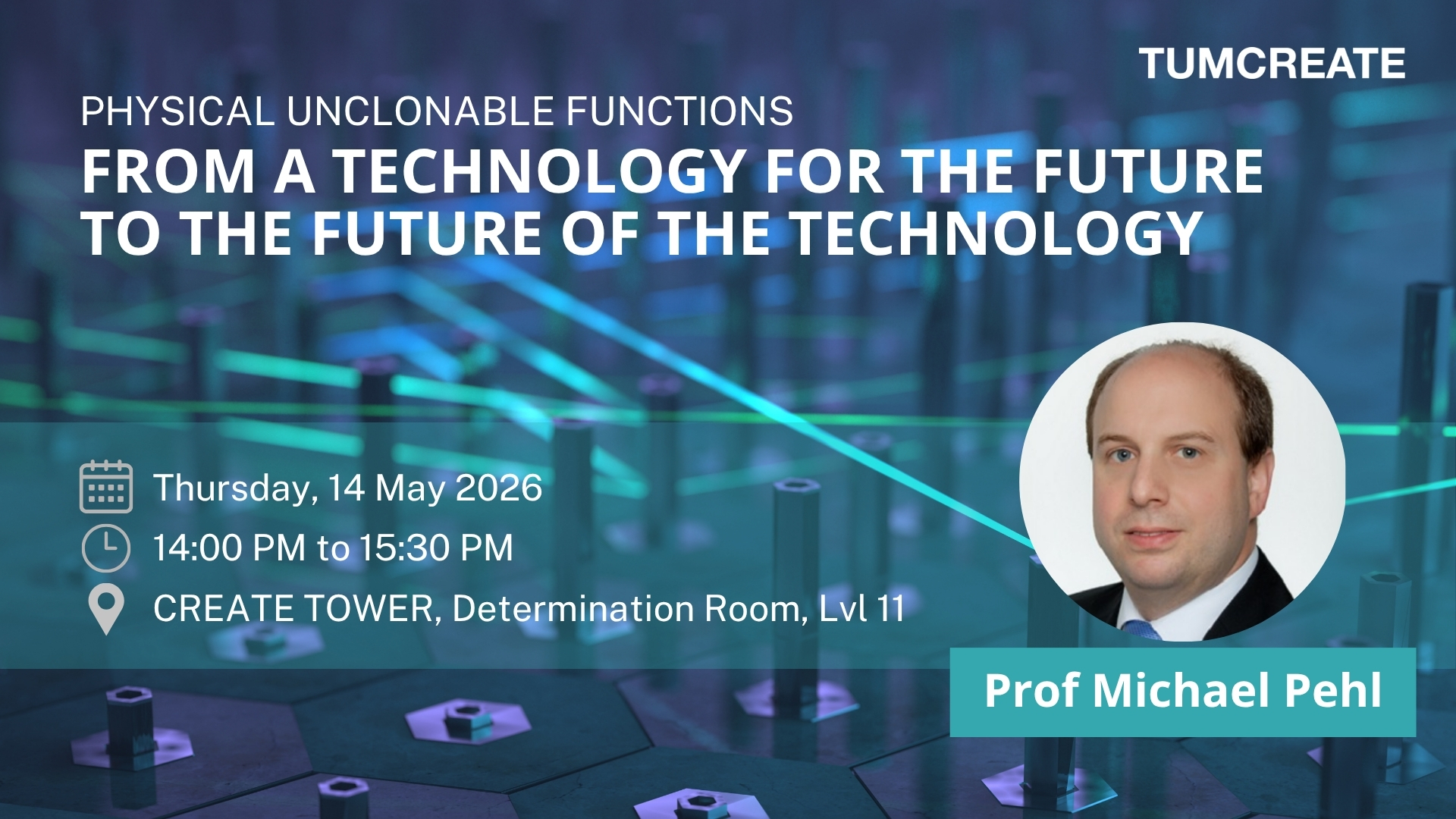
Talk: From a Technology for the Future to the Future of the Technology
14.05.2026Synopsis
Physical Unclonable Functions emerged over the past 25 years from a pure scientific construction to security primitives in products nowadays. But where do we stand? What are the gaps between promise and reality? And where to go from where we are? This talk sheds light on these questions.
To this end, it will firstly recap a few typical PUF constructions and show how they might be or are used in practical settings. With this background, we will discuss current trends in attacks onto such PUF constructions. Focusing later on future aspects, the talk will discuss how PUFs might be used in future applications to protect chips against tampering and as lightweight protection for sensors.
It will also discuss how PUFs can go together with Post-Quantum Cryptography, Quantum Key Distribution, and Physical Layer Security, where limits are to be expected and to which extent PUFs might or might not be useful in a post-quantum world.
Date: Thursday, 14 May 2026
Time: 14:00 to 15:30
Location: CREATE Tower, Determination Room, Level 11
Register for the talk: https://forms.office.com/r/fiRW0yCmsr
About Professor Pehl
Michael Pehl received his Dr.-Ing. degree (summa cum laude) in 2012 from the Technical University of Munich. For this work on the development of optimization algorithms for yield-aware analog circuit sizing considering discrete design parameters at the Chair of Electronic Design Automation he has been awarded with the Kurt-Fischer Prize in 2013. In 2024, he completed his habilitation in hardware security in 2024 with a thesis entitled "Design, Evaluation, and Application of Security Primitives that are Based on Hardware-Intrinsic Features".
He currently holds a permanent research position and the position of an Adjunct Teaching Professor (Privatdozent) at the Technical University of Munich. He leads a research group on Hardware-Intrinsic Security and focuses his current research on Physical Unclonable Functions. Further research interests include topics like secure hardware implementations, true random number generators, hardware related attacks, and practical implementations of physical layer security. He is member of the Center of Competence for Design of Electronic Circuits and Systems (DECS) at TUM, member of VDE, IACR, and IEEE, and serves as associate editor for the IEEE Transactions on Information Forensics and Security and as program committee member for several conferences.
In addition, he teaches a number of courses around circuit design and security and has developed and is responsible for TUM’s Master in Microelectronics and Chip Design.