

- QUASAR
- AquaCycle
- Proteins4Singapore
- Singapore's Pathway to Carbon Neutrality
- CellFACE
- LightSPAN
- Computational Modelling Group
- Energy and Power Systems Group
- SITEM - Singapore Integrated Transport and Energy Model
- Past Projects
News
Can Singapore Grow More Food Without Growing Its Carbon Footprint?
New research published in Nature Communications by Proteins4Singapore defines the energy limits of low-carbon indoor farming 24.03.2026On grocery runs in Singapore, we don’t usually think about where our vegetables come from. Maybe we glance at the country-of-origin label – Malaysia, China, Australia – and move on. Yet when supply chains falter due to a pandemic, geopolitical tensions or unpredictable weather, the effects are felt quickly on our plates (and wallets). For a land-scarce city that imports more than 90% of our food, resilience is not abstract, it is immediate.
But what if our vegetables were grown just a few kilometres away?
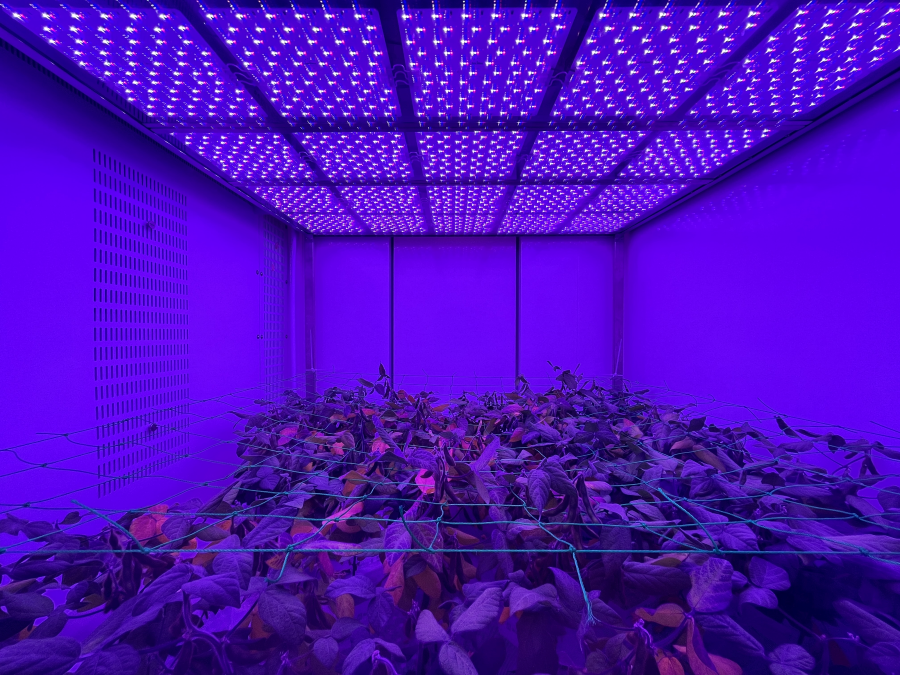
Vertical farms. Step into one and you won’t see soil or sunlight. Instead, rows of leafy green kai lan and arugula growing under bright purple LED lights. All in carefully controlled temperatures shielded from rain, pests and climate volatility. It very well looks like the future of farming!
Except, that future runs on electricity – a lot of it.
Singapore has set a target to produce 30 percent of its nutritional needs locally by 2030 (otherwise known as the 30 by 30 goal). To achieve this, the government has invested in high-tech solutions such as vertical farms and controlled environment agriculture (CEA), where crops are grown indoors under tightly managed light, temperature and humidity.
These innovative systems promise food security during uncertain times. Yet they also rely heavily on energy. As Singapore advances its push for food resilience, a critical question emerges – can we grow more food without growing our carbon footprint?
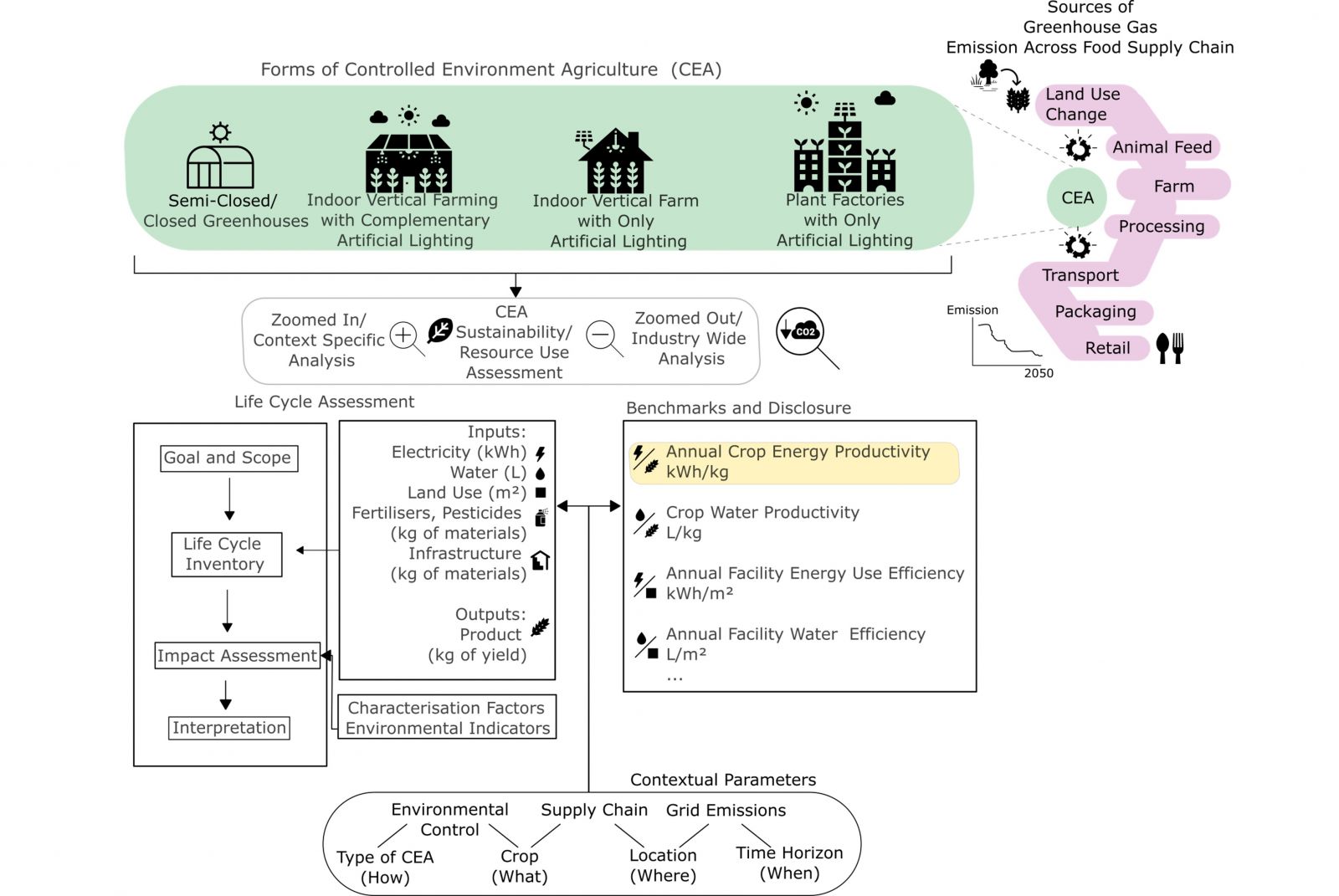
In a recent study published in Nature Communications, Dr Ng Shiwei (TUMCREATE), Professor Kai-Olaf Hinrichsen (Technical University of Munich), and Professor S. Viswanathan (Nanyang Technological University of Singapore) proposes a new way to answer that question by defining what they call a Maximum Energy-use Threshold (MET). Their research suggests that the sustainability of indoor farming depends not just on growing locally, but on how much energy is used and where that energy comes from.
.png)
Below, we hear from Dr Shiwei on the published paper:
Could you explain the concept of Maximum Energy-use Threshold (MET)?
We can think of it as a “budget” for how much electricity we can use to artificially create the optimal condition for growing food. This is defined as how much electricity you use to produce one kilogram of food. If you exceed this “budget”, then you are not prudent in how you use your resources and it will not be sustainable in the long run.
What were you trying to resolve in your research paper and why does it matter for how we grow food in Singapore?
We wanted to provide clarity on how the “carbon-saving” potential of growing crops in a controlled environment is dependent on local context - considering factors such as how food is being sourced and the availability of low-carbon energy.
Being able to quickly identify potentially “carbon-saving” ventures matter in Singapore because Singapore intends to reduce and stabilise its emissions intensity by 2030. This goal must be balanced with the goal of boosting local food productivity.
Many people think of vertical farms or indoor farms as “green” solutions. What does your research say about this?
There is a misconception that because vertical farms or indoor farms grow food locally, they eliminate food transportation and are “greener”. This research confirms that even if the assumption of eliminating food import is true, the “carbon-saving” potential of such a solution depends on how much electricity they use. We find that given the current electricity use estimates of vertical farms/ indoor farms in Singapore, most are not a “greener” option.
Why is energy use such a critical factor in evaluating whether CEA is low-carbon or sustainable? Why isn’t it enough to simply grow food locally?
It is critical because CEA uses an enormous amount of energy. Why should we care about lower carbon options and just grow food? We must pursue a lower-carbon food production because our environment and its resulting services (food, water cycle, carbon cycle) is a common good. It has also been studied that climate change can adversely affect global food production. Hence, while achieving climate goals and food security can look like competing objectives, the two are intertwined and neither one should be ignored.
What are the biggest challenges – both practical and conceptual – in making CEA genuinely low-carbon at scale?
Practically, we need a more efficient way to provide light for plant growth. Perhaps fibre-optic cables that transmit natural light indoor for multi-level plant growth.
How might your findings influence policymaking around food security and climate action both in Singapore and the global scale?
Here, we provide an approach to calculate the MET as an objective and transparent measure of operational prudence that can achieve both food security and climate goals. Policymakers can use the MET as milestones in frameworks regulating production volume and incentivising sustainable innovations.
This research was conducted as part of Proteins4Singapore, a five-year strategic research programme hosted by TUMCREATE, dedicated to advancing plant-based alternative protein science and building a sustainable, high-quality protein food supply for Singapore. This initiative establishes a holistic research platform that integrates innovative cultivation techniques, state-of-the-art processing technologies, and new food engineering approaches alongside a molecular characterisation of flavour perception, toxicology, and health impact assessment of novel foods. Guided by techno-economic and techno-functional evaluations, the consortium aims to develop scalable and sustainable solutions for the future of alternative proteins.
Read the full paper here: https://www.nature.com/articles/s41467-026-68631-w#citeas
Publication detailsNg, S., Hinrichsen, O. & Viswanathan, S. Contextual conditions define maximum energy-use threshold in low-carbon controlled environment agriculture for agri-food transformation. Nat Commun 17, 880 (2026). https://doi.org/10.1038/s41467-026-68631-w