






Energy & Smart City
A multidisciplinary intra-CREATE project tackling Singapore’s urban heat island effect and the outdoor thermal comfort of the people who live in it.
The urban heat island (UHI) effect has become a matter for increasing concern because of its many, mainly negative, effects upon the quality of urban life. These include reduced thermal comfort for urban dwellers, and increased noise, air pollutants and greenhouse gas emissions. In tropical Singapore, increased temperatures due to UHI negatively affect the liveability and thermal comfort of residents, and many of these problems are likely to become more severe in future — partly because of urban growth, but also because of the impacts of climate change upon cities.
Cooling Singapore was a multidisciplinary intra-CREATE project, with collaborations from NUS, TUMCREATE, Singapore-ETH Centre and SMART. The team used modelling tools and field measurements to better understand the sources of heat, find solutions to mitigate the UHI, and improve outdoor thermal comfort (OTC).
Reducing the UHI effect brings considerable benefits to Singapore, measurable not only in economic terms but also in the improved health and wellbeing of citizens. Achieving a substantial and lasting reduction, however, is a complex undertaking that necessitates an all-of-government approach, with implications for planning, transportation and construction as well as patterns of individual consumption. For all these reasons, the project set out to develop a roadmap to guide the emerging strategy.
Define a suitable metric for thermal comfort, and map the areas of Singapore most affected by the urban heat island.
Identify viable mitigation strategies, evaluate how effective they would be in the hotspot areas, and systematically map the knowledge and technology gaps.
Establish a UHI task force with key public and private sector players, and document findings in reports discussed at workshops and events.
Build a tool prototype to support the research and roadmapping work, and to make it easier for third parties to use the models developed.
Scenarios combining long-term and short-term mitigation measures, to illustrate possible routes towards improved thermal comfort.
A systematic map of knowledge and technology gaps, to help steer future R&D activity in Singapore.
A standing group of UHI experts from academia and government, convened to exchange knowledge, share insights and discuss scenarios.
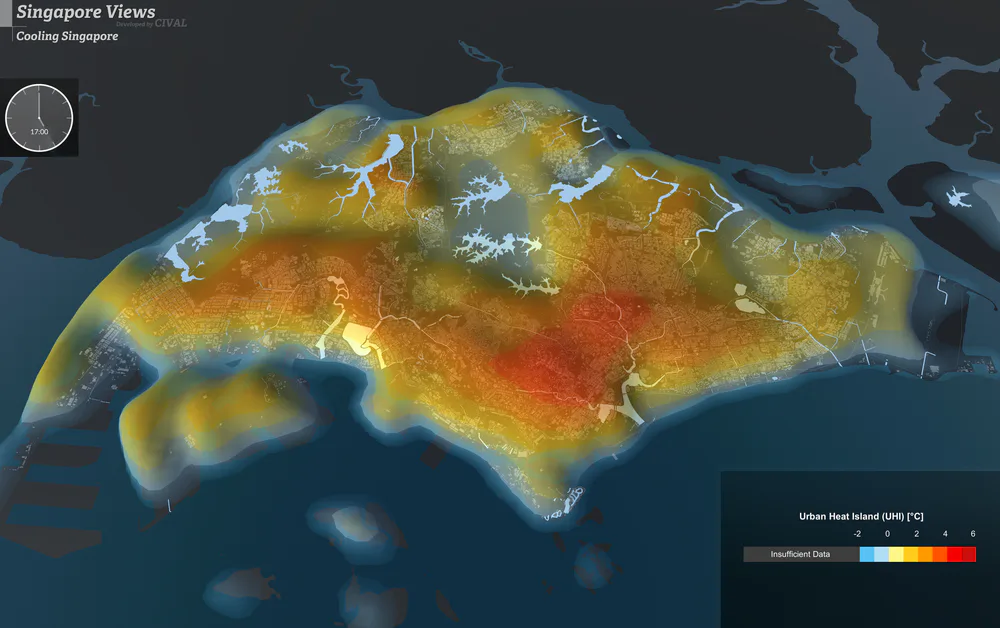
The project produced modelled maps of UHI intensity across the island, maps of the anthropogenic heat released by buildings in the CBD — waste heat ejected by air-conditioning systems, and one of the reasons the heat island is more intense there — and a risk-assessment tool that combines outdoor comfort with land use, so that urban planners can weigh different strategies. In a courtyard, for example, the tool helps target improvements where human activity is highest, such as playgrounds.