CityMoS

Page Banner

People Behind the Science – Dr Daniel Zehe

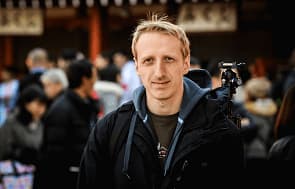
At TUMCREATE, as we prepare to conclude our research in Phase Two – Towards the Ultimate Public Transport System, we would like to highlight our researchers who continue to make significant contributions to the programme. Through our interview series, People behind the Science, we talk to our researchers to discover more about them and their stories.   We talk to Dr Daniel Zehe of the team Area-Interlinking Design Analysis (AIDA).   Besides holding the role of a computer scientist, Daniel can be considered quite a chef as well. Outside of work, Daniel loves to dabble in culinary and come up with innovative creations. He proudly shared that he once made and designed chocolate in the shape of a penguin and even concocted a dish, shaped like the German flag, with mashed potatoes, red cabbage and meatballs!   Q: Tell us about yourself and what you do… I am Daniel and I am currently a research fellow in the AIDA group. I have a master and bachelor degree from the Otto-von-Gericke University Magdeburg, Germany in Computer Systems in Engineering and received my PhD from Technical University of Munich (TUM) in 2019. Before joining TUMCREATE in Singapore, I was finishing my master thesis with an industry visit to draw my thesis at BMW Research and Technology in Munich.   My main field of research is the optimization and tool-chain development of agent-based simulation software as well as the related aspects of cloud computing. On a day-to-day basis, I am working on the design and coherence of the CityMoS mobility simulation platform. This includes meeting with full-time developers and modelling experts to discuss implementation strategies and performing implementations on CityMoS. It involves larger design decisions that require an overview of the entire simulation toolchain.   Q: What made you come to Singapore, and how has it been like living here? During my master studies, I developed two plans for myself. One was to stay in research and the second was to spend some time abroad. My research interests back then consisted of simulation and electrical engineering and the promise of TUMCREATE Phase One, research on the electrification of transport and use of simulation, was a perfect fit. The fact that I could also pursue a PhD at the same time was a bonus, at that point of time I wasn’t even planning to do a PhD!   Since living here in 2012, I have never regretted my decision. Not having winter and snow is a really nice benefit. Living here has also changed my view of my home country’s beauty. I became more appreciative whenever I go back and the small things that seemed normal before mean much more to me now.   Q: Who or what inspired you to be in your field of research? Being from a generation that was first to have access and use of the internet regularly at a young age, the workings behind such an integral part of my social upbringing intrigued me a lot. The fact that I could experiment with the inner workings without the fear of actually breaking anything or causing real damages since it is just a software, allowed me to be curious and explore more in this area. Having an interest in areas like physics or chemistry when growing up would probably be much harder and more dangerous than writing codes!   Q: What are some of the challenges for you in your field of research? As in all areas of research, disseminating information and solutions to everyone who will directly or indirectly benefit from them is challenging. Showing that problems exist and that we, as computer scientists, can improve and make things better with our research is a tough thing to do as the problems are quite complex and abstract. Especially in computer science research, the research questions and solutions are very much hidden in plain sight. For example, on a normal day, an average smartphone user can come across so many fascinating computer science problems that have not been optimized or improved and they don’t even realise that the problems are there. This makes people less receptive to want improvements.   In my main field of research, software development and cloud computing, the optimal usage of resources can prove to be a challenge too. It is never easy to know what is the right approach to use the resources efficiently since it depends on many factors. This is when creativity and experience are necessary to assemble different algorithms in the right order to make them behave in the way required for the given use case.   Q: Tell us about your work and journey in TUMCREATE… I have been with TUMCREATE since 2012. First as a research associate during my PhD, and now as a research fellow. Since joining TUMCREATE during its Phase One, I have been involved in various projects namely EVA, the electric taxi prototype, and CityMoS, our City Mobility Simulator. Being a part of the EVA project team and presenting the prototype at the Tokyo Motor Show will always be a great memory for me. It was a great culmination of the team’s hard work and sweat.   Today, my work includes the architecture and vision of CityMoS such as coordinating the implementation work for CityMoS and other software tools. This includes turning the abstract research work, bachelor thesis or final year project of our students, finishing their master or bachelor studies with a stay at TUMCREATE, into features that enhance and add value to the CityMoS platform.   Q: What are some of your plans in the future? My intermediate plans are to keep working on the simulation tools that we have been developing in AIDA. It would give me great pleasure to see CityMoS being used to facilitate decision making that can bring actual differences in people’s lives.   (A computer scientist and an avid cook, lets see what other skills Daniel would like to have.)   Q: If you could easily pick up a new
Page Banner

People Behind the Science – Marc Gallet

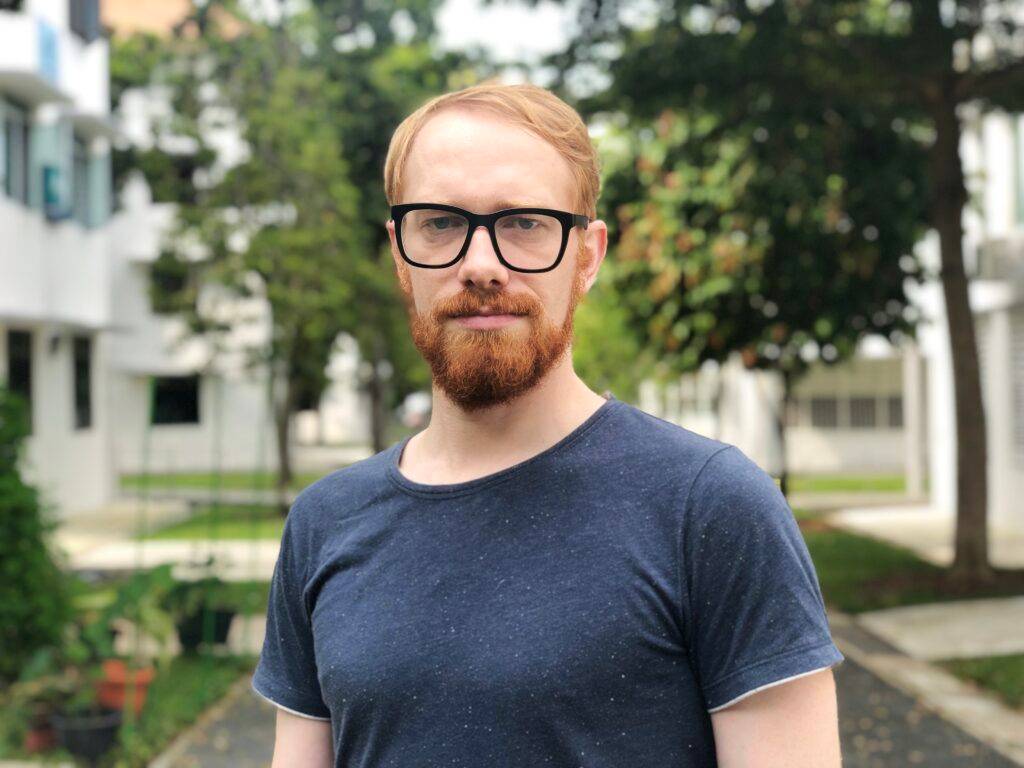
At TUMCREATE, as we prepare to conclude our research in Phase Two – Towards the Ultimate Public Transport System, we would like to highlight our researchers who continue to make significant contributions to the programme. Through our interview series, People behind the Science, we talk to our researchers to discover more about them and their stories.   Marc Gallet from the team Electrification Suite and Test Lab (ESTL) joins us today.   Most TUMCREATE researchers have lived in multiple cities and Marc is no exception. France, Munich and Singapore are all places he calls home. As a well-travelled individual, he dreams of being allowed to become a global citizen one day. With so many to achieve in his life and work, what gets him going is his love for computers and programming. For him, music is a great company when he’s in action – problem solving.    Q: Tell us about yourself and what you do… My name is Marc Gallet and I am a researcher and doctoral candidate in the ESTL team. Our team’s focus is to study the integration of electromobility and renewable energy solutions in the electric grid.   For my PhD topic, I work more specifically on the electrification of public buses. I develop city-scale models to determine the energy needed for electric buses to perform their trips and the electric power required at charging stations to recharge them. My work is at the interface between mobility simulation and modelling and energy system analysis. Coming from an electrical engineering background, I have become very interested in public transportation and mobility models and these past years have been a great learning opportunity.   Q: What made you come to Singapore, and how has it been like living here? It’s actually a long story but here’s the short version! Back in 2012 when I was studying in Munich, I lived in a shared apartment with other international students from all around the world. Each semester, there would be a change of roommates and as fate would have it, I met my future wife! She was doing her semester exchange from Nanyang Technological University. After she returned, I visited her on a holiday and discovered Singapore for the first time. I was greatly impressed by the city. Fast forward to 2017, I got the opportunity to join TUMCREATE and work in my favourite field of research. Without a doubt, I took up the offer and started to settle down and live with her here.   I adapted to the climate and lifestyle here very quickly, especially since I love summers in general, so a place with all-year-round summer is just perfect! My favourite aspects of living in Singapore include the multicultural working and living environment, a great public transport system and the wonderful variety of food.   Q: Who or what inspired you to be in your field of research? During the early days of my studies, I’ve always been attracted to the field of energy, the ubiquity of it and the fact that it will always be an essential. Also, I think that the necessity to move towards more sustainable energy sources and usage is one of the most important challenges we face.   At a young age, I was immersed in computers and love programming. Thus, after my initial studies, I started working in a research institute in Germany where I programmed various models for the forecast and integration of renewable energies. In one of the projects, we studied electric cars with a field test and that intensified my interest for electromobility. In TUMCREATE, I am able to combine both aspects of mobility and energy modelling while working on a concrete case-study.   Q: What are some of the challenges for you in your field of research? In the field of simulation and modelling, access to detailed data from the real-world is one of the main challenges. The data is necessary to improve the models and obtain results that can be accurate and applied outside of a pure academic context.   To give an example, I am simulating the operation of electric buses based on the existing Singapore public bus network. However, the real energy consumption of electric buses in a tropical climate might differ from expectations, like the energy-demand for air-conditioning and local traffic conditions. Since field trials of electric buses have started this year in Singapore, I am eager to discover how my simulation results will compare to real-world measurements and to improve the models based on feedback from the field.   Q: Tell us about your work and journey in TUMCREATE… I joined TUMCREATE in 2017 as a Research Associate to work on the topic of electrification of public road transport. From my research, I wanted to create a city-scale model of bus electrification. This required me to discover and learn more about the public bus network in Singapore. As mentioned, I was quite impressed by its density and level of service but had only personally experienced a few bus lines before. Through this work, I was able to quickly learn about all the different parts of Singapore’s bus network.   Initially, my study used historical data to calculate the energy demand that would be consumed if the current bus fleets were operated with electric buses. However, historical data has its limitations and I needed to pivot towards an approach based on flexible simulations for future predictions. This brought me to contribute to CityMoS, the city-scale mobility simulator mainly developed by the AIDA team. With the help of fellow colleagues from AIDA and students that I was supervising, I lead the implementation of a full model of electric public bus operation and charging within the simulator. Using it, we can simulate a wide range of electrification scenarios for buses with great level of details.   Q: What are some of your plans in the future? For the foreseeable future, I would like to have the opportunity to contribute to the development of electromobility in Singapore.

Page Preview

People Behind the Science – Dr David Eckhoff

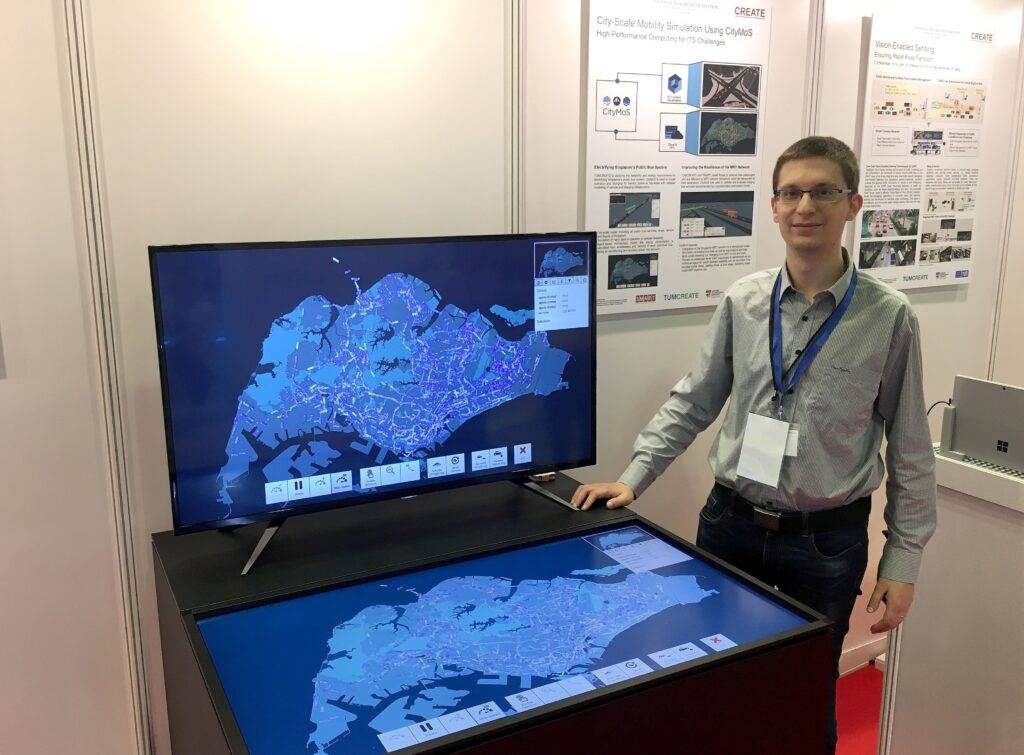
At TUMCREATE, as we prepare to conclude our research in Phase Two – Towards the Ultimate Public Transport System, we would like to highlight our researchers who continue to make significant contributions to the programme. Through our new series, People behind the Science, we talk to our researchers to discover more about them and their stories.   This time round, we have invited Dr David Eckhoff, Principal Investigator of the team Area-Interlinking Design Analysis (AIDA).     From research fellow to principal investigator in TUMCREATE, David’s dedication to his work is indisputable. A computer scientist from Bavaria, Germany, it is a common sight to see him working in front of his computer while drinking caffeinated drinks and listening to repetitive electronic music with headphones on. However, during the weekends, you can usually find him on the football pitch, playing for the German All Stars Singapore team.     Q: Tell us about yourself and what you do… My name is David Eckhoff and I lead the Computer Science team, AIDA, in TUMCREATE. Our focus lies in developing novel modelling and simulation solutions to better understand intelligent transportation systems. What we try to achieve is a digital representation of a large-scale transport system with a high level of detail. I’m also a part of several other research projects, together with NTU (Nanyang Technological University), NUS (National University of Singapore), MIT (Massachusetts Institute of Technology) and ADSC (Advanced Digital Sciences Center), dealing with privacy protection which I believe is an important topic in this day and age.   Q: What made you come to Singapore, and how has it been like living here? I fell in love with the country during my first visit in 2013. The organization, the transport system and the cleanliness really impressed me. Ever since I’ve moved to Singapore, I seem to have become a little bit spoiled because every time I travel overseas now, I get easily annoyed if something isn’t working as smoothly as I’m used to here. I also didn’t really have any problems adapting to the Singapore lifestyle. Although to be honest, the food ‘Laksa’ was a big shock to me, my stomach just couldn’t seem to take it. I also started learning Mandarin here which, I have to say, is way too difficult!   Q: Who or what inspired you to be in your field of research? For me, there weren’t many alternatives. I had spent the majority of my teenage years in front of a computer so naturally my occupation would need to be somehow related to that. I was always curious of how things work so I kind of just steered towards being a computer scientist. I didn’t really give it much thought when I enrolled into a Computer Science study programme. In fact, after my Master’s, when I had the choice of going into industry or academia to do my PhD, I took the route that was more compatible with my sleep cycle. I guess being able to work during the night and have longer sleep in the morning was my main motivation!   Q: What are some of the challenges for you in your field of research? I think the biggest challenge in my field, as well as many other fields of research, is to give your research real-life relevance. Even though in academia it is important to publish papers and optimize your academic numbers, I don’t find it very fulfilling if it is just for that purpose. Fortunately, the work I am doing at TUMCREATE now finds application not only in the Singapore context but also internationally. It is gratifying to see that what you and your team have worked on for so long finally contributes to solving problems in the real world.   Q: Tell us about your work and journey in TUMCREATE… I joined TUMCREATE in 2016 as a research fellow. Shortly after, I was fortunate enough to be given the opportunity to lead a bigger team and shape its research and development strategy. One of our biggest projects and achievements is our mobility simulator, CityMoS. It is exciting being able to contribute to the shaping of such a state-of-the-art software tool and be part of a collaboration with so many talented people. In general, I would say that being able to work closely with both experienced and younger researchers, as well as actively engaging with governmental agencies and industry stakeholders, has definitely been an important experience for me.   Altogether, I believe the CREATE program is a great environment for younger researchers to build their network and participate in interesting research projects. I mean, where else in the world will you have world-leading universities just across the hallway?   Q: What are some of your plans in the future? I definitely see my mid-term and possibly long-term future in Singapore. Together with my team, I would like to continue the work on CityMoS beyond the scope of TUMCREATE Phase 2. I would also be keen to continue teaching at one of the local universities. I’m usually not one to make long-term plans in advance, which is possibly also one of the reasons why I took a somewhat risky adventure of moving to a foreign country in the first place. I like to always have some level of uncertainty in my life and not have everything set in stone.   (Curious, we asked David the following question before we end the interview.)   Q: If you are not a scientist, what do you think you will be doing instead? That’s a tough one… I love playing football but given that I’m not a good enough footballer, this career option would probably not be a viable one. I think what I would really enjoy doing professionally is photography, preferably in the area of landscape, travel or architecture. In fact, given the current situation with COVID-19, my camera has been idle for way too long and I can’t wait to travel and start taking pictures again.   

Scroll to Top