CityMoS

TUMCREATE 15TH anniversary_

TUMCREATE Celebrates 15 Years in Singapore

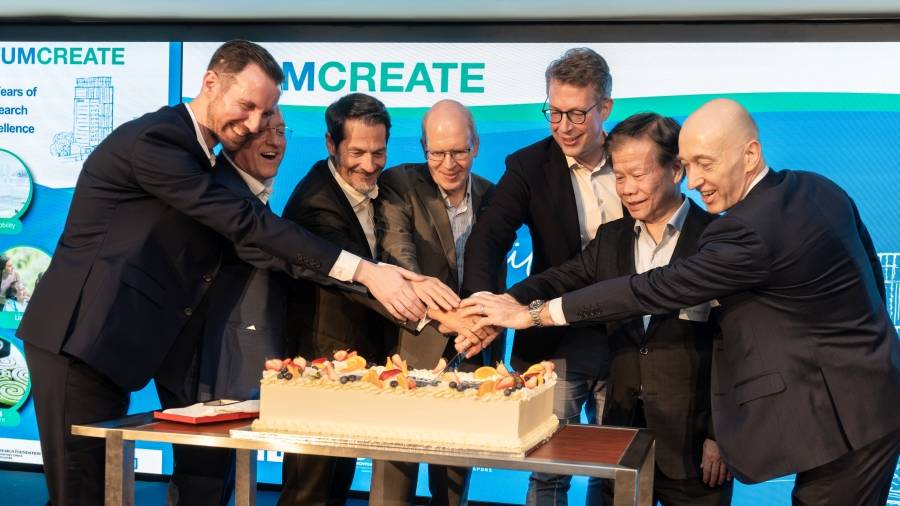
News TUMCREATE Celebrates 15 Years in Singapore TUMCREATE, the multidisciplinary research branch of the Technical University of Munich (TUM) in Singapore, celebrates its 15th anniversary — a milestone highlighting impactful research, pioneering innovation, and strategic collaboration to address real-world challenges since its inception in 2010. Bavaria’s Minister of Science Markus Blume and TUM President Prof. Thomas F. Hofmann took part in the celebrations during their visit to Singapore. Hosted under Singapore’s National Research Foundation (NRF) Campus for Research Excellence And Technological Enterprise (CREATE), TUMCREATE has contributed to advancing scientific solutions and a legacy of impact. TUMCREATE has been driving research across diverse domains such as electromobility, sustainable food solutions and processing technology, energy systems, and health tech with other leading Singaporean and global universities and research institutes. TUMCREATE’s current flagship programme, Proteins4Singapore, addresses the critical need to ensure a sustainable, nutritious, and secure food supply in rapidly growing urban environments and supports Singapore’s ’30 by 30′ food security goal of producing 30% of its nutritional needs domestically. The collaborative environment at TUMCREATE has enabled deep academic and research exchanges leading to positive results. One successful milestone was EVA, the world’s first electric taxi for the tropics, developed in 2015 in collaboration with Nanyang Technological University. TUMCREATE’s simulation technologies City Mobility Simulator (CityMoS) and Multi Energy System Modelling & Optimisation (MESMO) have been used in various government and industry projects to support the electrification of Singapore’s transport systems, infrastructure planning, and traffic flow optimisation. Based on a digital twin of Singapore, CityMoS’s utilisation to simulate traffic and mobility systems in real time has extended beyond Singapore through its commercial spin-off, intobyte. TUM President Prof. Thomas F. Hofmann says: “TUMCREATE, as a vital part of our activities in Singapore, exemplifies the spirit of scientific excellence, the passion for impact, and the added value of international cooperation that defines our university’s global mission. It brings together talents from different disciplines and continents, converges German engineering competences and Asian ingenuity, and connects TUM’s entrepreneurial spirit with Singapore’s dynamic innovation systems. I am confident that our teaching and research activities in Singapore will help to shape a smarter, more sustainable future – together.” Bavaria’s Minister of Science Markus Blume says: “Happy birthday! We are celebrating the 15th anniversary of an international success story. The cooperation between our Bavarian innovation ambassador, TUM, and the who’s who of innovation makers from Singapore has created a very special spirit. TUMCREATE is a strong platform for research cooperation between the innovation regions of Bavaria and Singapore – a bridge of excellence between the continents. For us, it is clear that innovation comes from cooperation.” Professor Subodh Mhaisalkar, NRF Executive Director says: “Over the past decade and a half, TUMCREATE has built robust partnerships with local institutions and industry, developing innovative solutions across various domains including sustainability, urban mobility, food sciences and nutrition. While bridging the gap between cutting-edge research and practical applications, the centre has provided solutions for topics related to deployment of electric vehicles, cargo management, and resource circularity.” Advancing TUM’s Global Mission The success of TUMCREATE today reflects TUM’s mission to drive excellence in research and innovation. TUMCREATE is now setting its sights on new frontiers including healthcare, artificial intelligence and quantum technologies to advance solutions that align closely with Singapore’s Research, Innovation and Enterprise strategies. Prof. Ulf Schlichtmann, CEO of TUMCREATE, says: “Pioneering solutions and impactful real-world applications are ingrained in our scientific approach. We look forward to many more successful years of pushing the boundaries of science and innovation with TUM and our academic and industry partners in Singapore.” About TUMCREATE Following the inception of TUM Asia as TUM‘s teaching branch in Singapore in 2002, TUMCREATE was founded in 2010 as a multidisciplinary research center in Singapore. TUMCREATE fosters collaborative research between the Technical University of Munich (TUM) and the world’s leading universities, local institutions, and public agencies as well as regional industry partners to contribute to the sustainable transformation of societies through science and technology. Funded by the National Research Foundation, TUMCREATE’s multi-faceted research projects span topics from urban mobility, food science and technology, biomedical technology, and preventive care to solutions for a carbon-neutral megacity. Over the last years, the research teams presented more than 1,000 publications, with more than 150 doctoral students and postdocs qualified for a career in research and industry. About Singapore’s CREATE CREATE is an international collaborative housing research centres set up by top universities. At CREATE, researchers from diverse disciplines and backgrounds work closely together to perform cutting-edge research in strategic areas of interest, for translation into practical applications leading to positive economic and societal outcomes for Singapore. The interdisciplinary research centres at CREATE focus on four thematic areas of research, namely human systems, energy systems, environmental systems and urban systems. Media and Communications: communications@tum-create.edu.sg ← Back to News

Trends and Predictions for AI in 2025

Trends and Predictions for AI in 2025

News Trends and Predictions for AI in 2025 Leading experts at TUM and TUMCREATE weigh in on Artificial Intelligence (AI) including agentic AI AI is revolutionising science and reshaping industries. It increases our efficiency and can transform how researchers and decision makers analyse large amounts of data, identify patterns and model complex systems. This could accelerate scientific breakthroughs, redefine impact and streamline workflow automation. Read the insights from experts across AI-assisted medical imaging, urban transport planning and more! From Bench to Bedside: AI revolutionising healthcare The recent hype in AI aside, one thing is clear – AI is here to stay. There is no doubt, one of the largest and most crucial sectors for society that AI will improve is healthcare, from enhancing patient satisfaction in hospitals to robotic surgeries. We anticipate rapid growth in cellular imaging-based diagnostics as AI continues to drive personalised and preventive medicine in the coming years. This progress will translate into faster, more precise, and information-rich test results for clinicians—offering insights that simply weren’t possible with traditional image and data-processing algorithms. That’s why at CellFACE, we are at the forefront of advancing AI-enhanced imaging flow cytometry for haematology and infectious diseases, leveraging our patented technology to uncover hidden biomarkers. We also recognise Singapore as an excellent ecosystem for conducting clinical studies, ensuring that innovative AI-based medical solutions reach patients quickly and cost-effectively. As we look ahead, one thing remains certain. AI will continue to revolutionise healthcare, enabling us to deliver better patient outcomes, more efficient workflows, and ultimately shape a healthier future for everyone. – Kerem Delikoyun, Research Associate at TUMCREATE, CellFACE Trends Shaping AI-assisted medical imaging in 2025 Photo credit: Juli Eberle / TUM There are several trends which will shape the field in 2025. The first trend is the significant growth of foundation models in the field of medical imaging. A foundation model is a large-scale, pre-trained neural network that serves as a general-purpose model for a wide range of tasks. These models are trained on vast amounts of data and can be fine-tuned for specific applications. In the context of medical imaging, these models can significantly improve medical imaging by enhancing accuracy, efficiency, and accessibility, ultimately leading to better patient care. A second trend is the development of large language models (LLMs, such as chatGPT), in particular vision language models (VLMs). Such VLMs understand and generate both visual (e.g. understanding radiological images) and textual information (e.g. understanding radiological reports). Since VLMs can learn the relationships between visual and textual information, they can be used for a wide variety of tasks such as Visual Question Answering (e.g. “show me the tumour in the image”) or Report Generation. This provides a completely new way to interface with AI systems in the context of radiology and pathology. Agentic AI – autonomous action and decision-making One important trend is the emergence of agentic AI systems in medicine and healthcare. In particular, LLM-based agentic systems are capable of processing input information, making plans and decisions, recalling and reflecting, interacting and collaborating, utilising various tools, and taking action. This capability unlocks numerous opportunities in medicine and healthcare, from automating clinical workflows to supporting multi-agent-assisted diagnosis. This is also described in a recent publication [1]. Challenges, transformation and future of medicine and healthcare I expect that the transformative impact of AI in medicine and healthcare will continue, but the speed of adoption will be limited by the fact that clinical translation requires careful validation of AI solutions, understanding AI regulations but also understanding clinical needs and workflows. To tackle these challenges, it will be crucial for multi-disciplinary teams to work together to advance AI for the benefit of patients and doctors. I also expect that the future of biomedical research will be fully data-driven: Experiments will increasingly be guided by data-driven AI models, complementing the currently prevalent serendipity-based methods. This approach will be applicable to both basic research and clinical translation. Just as engineering has facilitated the simulation-based design of cars and planes, data-driven system models will revolutionise human health by enabling the development of therapeutic strategies and precision diagnostics. – Prof. Daniel Rückert, Alexander von Humboldt Professor for AI in Medicine and Healthcare at the Technical University of Munich. Navigating AI and AI-human interactions The scientific community increasingly recognises AI’s importance in research, as evidenced by recent Nobel Prize awards in Chemistry and Physics for AI-related breakthroughs. We’ll see the merging of traditional knowledge silos, with AI serving as a bridge between different scientific disciplines. However, with the current AI hype, one of the big challenges I foresee on the application side is to acknowledge and understand the limitations of certain AI approaches, especially when reasoning and explainability play an important role. Domain expertise must remain at the core of innovation. That’s why Singapore’s National AI Strategy[2] is so important as it allows us, researchers, to strengthen the very foundation on which future technology will rely on. I believe there’s significant potential to improve how humans interact with complex software, particularly expert tools. By incorporating powerful natural language interfaces and AI agents capable of deriving insights and executing concrete actions, we can flatten traditionally steep learning curves and make these tools more intuitive and productive. For CityMoS (City Mobility Simulator), our transport planning software, this could mean AI agents analysing large datasets, identifying key metrics, and automating the extraction of insights, enabling users to focus on strategic decisions rather than on technical details. – Dr. David Eckhoff, TUMCREATE Principal Scientist and Business Development Manager, Co-Founder intobyte (a spin-off from TUMCREATE) References Qiu, J., Lam, K., Li, G. et al. LLM-based agentic systems in medicine and healthcare. Nat Mach Intell 6, 1418–1420 (2024). https://doi.org/10.1038/s42256-024-00944-1 Singapore National AI Strategy 2.0 (NAIS 2.0) | Ministry of Digital Development and Information (2025) Available at: https://www.smartnation.gov.sg/nais/ Media and Communications: communications@tum-create.edu.sg ← Back to News

TUMCREATE BMDV Visit_March 2023 (2)

Federal Ministry of Transport and Digital Infrastructure (BMDV) Visit to TUMCREATE Ignited Rigorous Discussions in the Mobility Domain

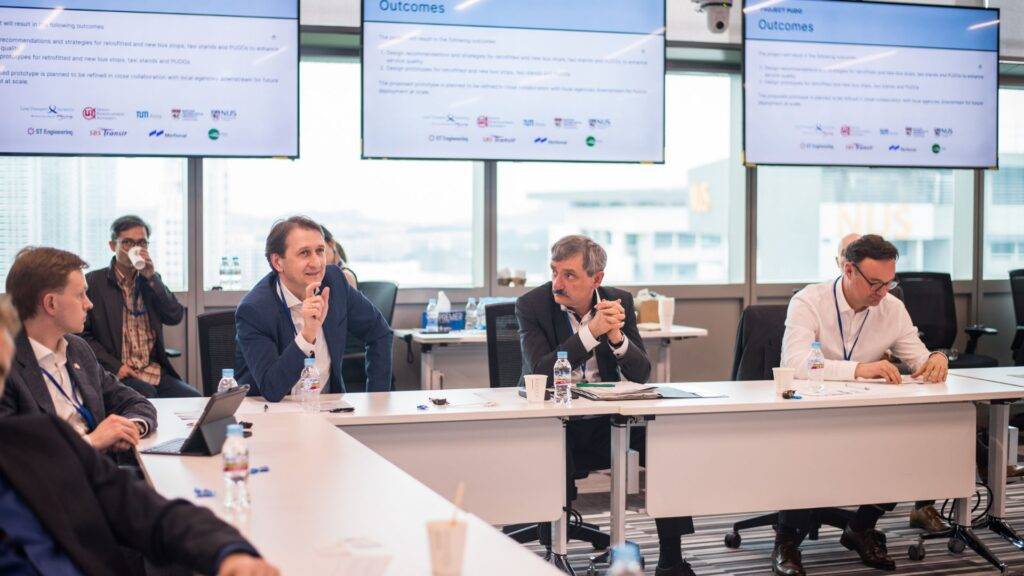
On 22 March 2023,TUMCREATE had the honour of receiving Mr Oliver Luksic, the Parliamentary State Secretary to the Federal Minister for Digital and Transport, from the German Federal Ministry for Digital and Transport (BMDV) and his delegation, in which the Principal Investiros presented highlights of the mobility research projects undertaken by TUMCREATE and TUM Asia. The visit culminated in several insightful discussions between the delegation and TUMCREATE’s researchers regarding the mobility landscape in Singapore and Germany.  Dr. David Eckhoff, Principal Scientist,  Director of the Simulation Lab at TUMCREATE and Co-Founder of the spin-off company, intobyte, introduced the City Mobility Simulator – #CityMoS – a high-resolution and high-performance digital twin solution for city-scale transport systems. In traffic-laden cities like Singapore, CityMoS gives transport planners a holistic picture of a city’s traffic demands depending on the time of the day, and its the effect on energy consumption, giving rise to more sustainable mobility solutions for cities.     Dr Graham Leedham presented the #Pickupanddropoff (PUDO) project, a result of TUMCREATE’s former mobility programmes. As the intersection of road and pathways, pick-up and drop-off points tend to be busy, comprising heterogenous and erratic traffic. Adding autonomous vehicles into the mix, picking up and dropping off passengers at such points are often the most complex and challenging tasks at hand. Through intensive research of passenger and traffic behaviour under the project hosted by TUM Asia, the research teams devised improvisations to provide an optimal user experience.   It was a fruitful discussion between the delegation and our lead principal investigators exchanging views on the mobility trends and developments in Germany and Singapore, providing some insights into the mobility challenges presented in cities in which TUMCREATE hopes to address them beyond the distinguished delegation’s visit.   

TUMCREATE researchers recognised for contributions to Singapore’s 2040 vision for all vehicles to run on cleaner energy

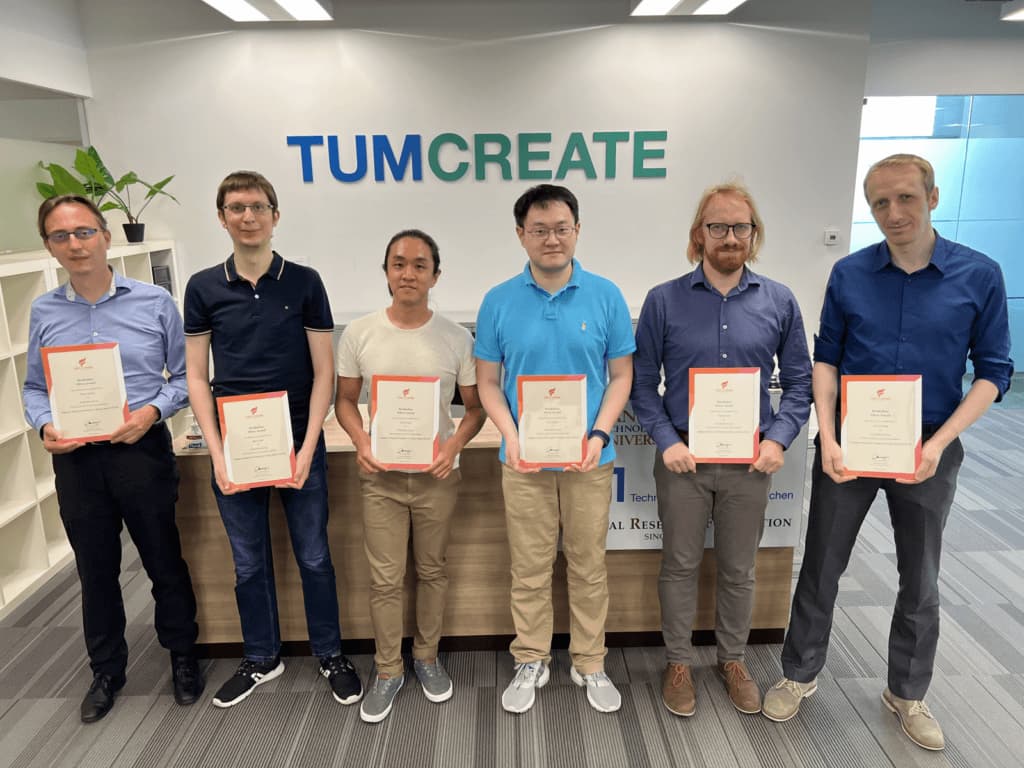
The SITEM project team including TUMCREATE researchers has received the prestigious Borderless Silver Award 2022 in the annual Firefly Awards by the Ministry of Trade and Industry, Singapore (MTI). The annual Firefly Awards celebrate the best of ideas as well as recognise teams and individuals within the MTI Family who have exemplified strengths in the respective Award categories. The TUMCREATE researchers Dr Tobias Massier, Dr David Eckhoff, Dr Daniel Zehe, Marc Gallet, Kuo Yu-Jeng, Xiao Jiajian, and Dr Arif Ahmed were honoured when their efforts were recognised by the Ministry of Trade and Industry, Singapore (MTI). The team would also like to thank fellow researchers and previous team members Dr Sebastian Troitzsch, Andrej Trpovski, and Nagacharan Teja Tangirala for their efforts and achievements, contributing to the success of the research project. From left: Dr Tobias Massier, Marc Gallet, Kuo Yu-Jeng, Xiao Jiajian, Dr Daniel Zehe, Dr David Eckhoff   The SITEM Project Team: A*STAR IHPC & TUMCREATE’s multidisciplinary researchers   Singapore’s 2040 vision to phase out internal combustion engine vehicles and have all vehicles run on cleaner energy to contribute towards Singapore’s decarbonisation commitments, requires a large-scale, multi-agency effort to provide charging infrastructure, electrify public vehicles, and upgrade the electrical grid to accommodate the new demand. The Singapore Integrated Transport and Energy Model (SITEM) describes a research project that supports Singapore’s planning for the transition to electric vehicles (EVs) nationwide. Commissioned by the Prime Minister’s Public Sector Science and Technology Policy and Plans Office (S&TPPO) and in collaboration with all relevant agencies, researchers from A*STAR and TUMCREATE set out to create the first high-fidelity, island-wide simulation of EV transport in Singapore. It is key project with public value for Singapore that TUMCREATE has been working on together with A*STAR’s Institute of High Performance Computing. SITEM is used to conduct a comprehensive analysis of projected electric vehicle (EV) charging patterns and energy demand, while integrating multiple aspects of mobility and energy modelling, including the movements of individual vehicles, drivers’ decisions about where and when to charge, and the interaction of EV charging demand with electricity grid capacity. The SITEM project builds on two primary simulation technologies developed by TUMCREATE: City Mobility Simulator (CityMoS) utilises high-performance computing techniques to enable high-detail transport simulation of the entire island of Singapore, while maintaining short turnaround times. Multi Energy System Modelling & Optimisation (MESMO) is an advanced software framework that combines simulation of electrical grids and optimisation techniques to mitigate the grid impact of distributed energy resources (such as photovoltaics) and new types of loads (such as EV charging). Robust modelling and simulation have potential to reap significant cost avoidance, as projects in the infrastructure and energy space are typically costly and hard to re-work once in the implementation stage. To model such a large-scale and multi-layered system at high resolution, the researchers are employing advanced capabilities including large scale complex systems modelling and optimisation, high performance and distributed computing, advanced data analytics and empirically grounded agent-based modelling of human behaviour. Through advanced scenario modelling and simulation, SITEM delivers insights on how Singapore can optimise EV charging stations’ placement to address drivers’ charging needs and to efficiently allocate energy demand and upgrades across the power grid. SITEM’s has enabled regulatory agencies to explore and evaluate varied pathways to vehicle electrification.   Further information on SITEM

DPM Heng _Dr

DPM Heng Swee Keat visits TUMCREATE

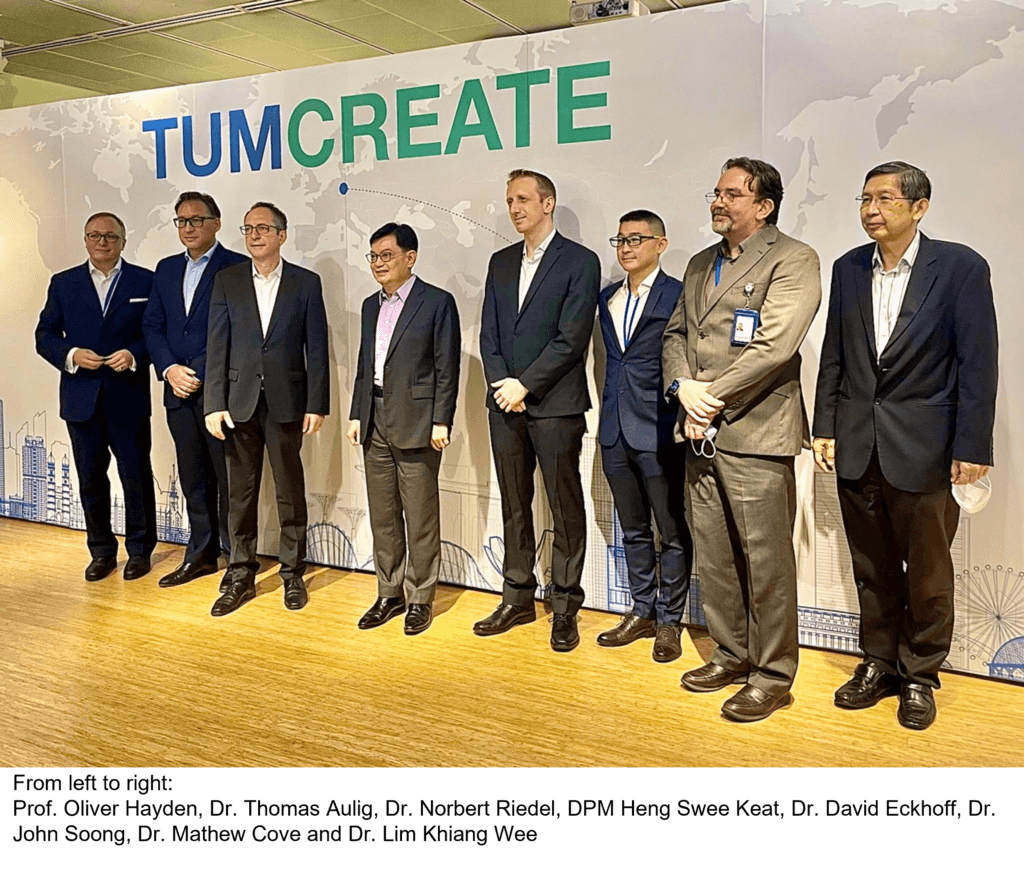
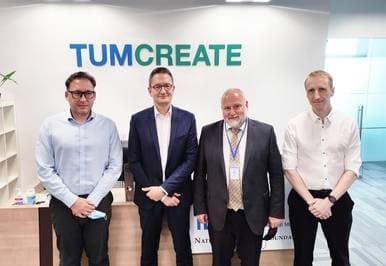
DPM Heng Swee Keat visited TUMCREATE in June 2022 to learn about the collaborative research projects with its Singaporean Partners.  The German Ambassador, Dr. Norbert Riedel was also present.   Dr. David Eckhoff (4th from the right) presented the CityMOS: City Mobility Simulator which was developed at TUMCREATE. Prof. Oliver Hayden (1st from the left)  and Dr. Matthew Cove (2nd from the right) presented CellFACE which will be developed at TUMCREATE as well.    TUMCREATE commits to driving innovation towards helping Singapore and the world move forward with urban sustainability.       Picture from left to right:  Prof. Oliver Hayden, Dr. Thomas Aulig, Dr. Norbert Riedel, DPM Heng Swee Keat, Dr. David Eckhoff, Dr. John Soong, Dr. Mathew Cove and Dr. Lim Khiang Wee 

Schnorr-Photo-small

German State Secretary at the Federal Ministry for Digital and Transport visits TUMCREATE

On 27 May 2022, the German State Secretary at the Federal Ministry for Digital and Transport Stefan Schnorr visited TUMCREATE to discuss research insights on mobility patterns and related energy demand of a Megacity like Singapore on its pathway to electrification with TUMCREATE’s lead scientists. TUMCREATE’s two primary simulation technologies, MESMO and CityMoS, were demonstrated and ideas which would be useful to testbed in Germany as well were explored. From left: Dr Thomas Aulig, State Secretary Stefan Schnorr, Heiko Wildner, Dr David Eckhoff Dr Tobias Massier showcased his research on the simulation of electrical grids and demonstrated TUMCREATE’s Multi Energy System Modelling and Optimisation (MESMO) tool, that combines simulation of electrical grids and optimisation techniques to mitigate the grid impact of distributed energy resources (such as photovoltaics) and new types of loads (such as EV charging). Dr David Eckhoff provided research insights on city mobility and demonstrated TUMCREATE’s City Mobility Simulator (CityMoS), which utilises high-performance computing techniques to enable high-detail transport simulation of the entire island of Singapore, while maintaining short turnaround times and enabling the efficient exploration of wide parameter spaces. The live coupling of the mobility simulator CityMoS and the power grid simulator MESMO provides insights into the dependencies of both systems. These advanced scenario modelling capabilities enable next-generation urban transport planning in smart cities. TUMCREATE’s simulation tools can answer a wide range of what-if questions in the urban mobility domain, such as placement of e-charging stations, while exploring and evaluating varied pathways to vehicle electrification.   Further information on CityMoS Further information on MESMO

SITEM_Visual_Eyecatcher_V04

Singapore’s first Integrated Simulation Model of Vehicle Electrification Created by A*STAR and TUMCREATE

Created in collaboration with relevant government agencies, this is the first island-wide integrated model to provide a comprehensive impact analysis of projected electric vehicle (EV) charging demands. A*STAR’s Institute of High Performance Computing (IHPC) and TUMCREATE Ltd (TUMCREATE) are working together on a research project that supports Singapore’s planning for the transition to electric vehicles (EVs) nationwide. The Singapore Integrated Transport Energy Model (SITEM) will be used to conduct a comprehensive analysis of projected electric vehicle (EV) charging patterns and energy demand, which will support policymaking on Singapore’s budget 2040 vision for all vehicles to run on cleaner energy and contribute towards Singapore’s decarbonisation commitments. The research project is commissioned by the Science and Technology Policy and Plans Office (S&TPPO), Prime Minister’s Office, and aims to advance the nation’s capabilities in integrated modelling and simulation of transport and power systems. Singapore’s 2040 vision to phase out internal combustion engine (ICE) vehicles and have all vehicles run on cleaner energy will involve a large-scale, multi-agency effort to provide charging infrastructure, electrify public vehicles, and upgrade the electrical grid to accommodate the new demand. Designed to support this effort, SITEM is the first high-fidelity, island-wide simulation of EV transport in Singapore that integrates multiple aspects of mobility and energy modelling, including the movements of individual vehicles, drivers’ decisions about where and when to charge, and the interaction of EV charging demand with electricity grid capacity. Through advanced scenario modelling and simulation, the project aims to deliver insights on how Singapore can optimise EV charging stations’ placement to address drivers’ charging needs and to efficiently allocate energy demand and upgrades across the power grid. Robust modelling and simulation has potential to reap significant cost avoidance, as projects in the infrastructure and energy space are typically costly and hard to re-work once in the implementation stage. To model such a large-scale and multi-layered system at high resolution, IHPC and TUMCREATE are employing advanced capabilities including large scale complex systems modelling and optimisation, high performance and distributed computing, advanced data analytics and empirically grounded agent-based modelling of human behaviour. The project team also draw on extensive experience in past and ongoing project collaborations with various local entities in the transport ecosystem, including transit operators, regulatory bodies and urban planners. The SITEM project builds on two primary simulation technologies developed by TUMCREATE in Singapore under its NRF-funded Mobility Programme: City Mobility Simulator (CityMoS) utilises high-performance computing techniques to enable high-detail transport simulation of the entire island of Singapore, while maintaining short turnaround times. . Multi Energy System Modelling & Optimisation (MESMO) is an advanced software framework that combines simulation of electrical grids and optimisation techniques to mitigate the grid impact of distributed energy resources (such as photovoltaics) and new types of loads (such as EV charging). Network data and modelling considerations were provided by the Energy Market Authority and national grid operator SP Group. While further development of SITEM is ongoing, preliminary findings from simulation studies conducted by the IHPC and TUMCREATE research team have enabled collaborating government agencies and industry partners to validate and refine their planning assumptions regarding such questions as the adequacy of electric charger provisioning to meet projected demand and the sufficiency of electrical grid capacity to support vehicle electrification requirements. In addition, SITEM’s advanced scenario modelling capabilities have enabled regulatory agencies to explore and evaluate varied pathways to vehicle electrification. For example, in light of the fact that private electric cars will generally park longer than the actual duration required for the car to charge fully, smart charge management can help to reduce grid infrastructure upgrade costs without compromising the overall energy provisioned to the electric cars. SITEM makes it possible to estimate the efficiency gains from such systems, and can model their impact alongside or in combination with other mechanisms such as incentive-based demand shifting, smart scheduling and local energy storage. Dr Lim Keng Hui, Executive Director of A*STAR’s IHPC, said “The beauty of simulation and modelling in urban planning is that we can integrate with multiple real-world datasets to create realistic computational models of our city, and explore different designs to achieve the optimal outcomes before physical infrastructure upgrade is commissioned. Our aim is for this collaboration to allow local government agencies to tap on A*STAR’s advanced systems modelling and simulation capabilities to better plan and support the electrification effort in Singapore. IHPC has years of expertise in land transportation research, and we look forward to this collaboration with TUMCREATE to undertake this national-level strategic modelling project.” Prof Ulf Schlichtmann, CEO of TUMCREATE, said, “It is with great pleasure that TUMCREATE is part of this exciting multi-stakeholder project, together with our partner IHPC and the various Singapore government agencies. I am delighted to see that our simulators, CityMoS and MESMO, play an important role in providing recommendations for the electrification of Singapore’s transport system. Since its establishment, TUMCREATE has been conducting innovative research in support of Singapore’s sustainability goals and this is a great opportunity for us to contribute further on and show the relevance of our technologies.” Er Pang Chung Khiang, Group Chief Systems Officer of S&TPPO, PMO, said, “This collaboration between the research teams and relevant government agencies allows for integration of the best from two research institutes to address national level challenges. The coupled transport and energy simulation model allow for continuous refinement of planning parameters to better understand interdependencies and emergent behaviours with new concept of operations for decision making. Modelling and simulation generate insights that brings downstream savings on infrastructure upgrades whilst allowing our agencies to focus efforts to enhance overall commuter satisfaction. These efforts dovetail with developments like our Smart Nation Initiative.”   About the Institute of High Performance Computing (IHPC) A*STAR’s Institute of High Performance Computing (IHPC) was established in August 1998 to provide leadership in computational modelling, simulation and AI to solve major scientific, industrial and societal challenges. It seeks to promote and spearhead scientific advances and technological innovations through multidisciplinary R&D, and to develop impactful applications to further economic

HW-TC Logo (2)

Huawei and TUMCREATE set up New Joint Innovation Lab in Singapore to Boost Mobility Simulation Research

Singapore, 23 April 2021 – Huawei and TUM CREATE Ltd (TUMCREATE) are entering a new partnership to set up an innovation lab, the Mobility in Virtual Environments at Scale (MoVES) Lab, in Singapore to conduct cutting-edge research that will enhance transport system simulation, facilitating and improving urban planning in smart cities.   For simulations to support real-world deployments and decision making, a high level of realism needs to be exhibited from the simulator. Currently, one of the biggest challenges is that most mobility simulators are unable to replicate more complex and challenging situations, such as busy intersections in some parts of Asia and the rest of the world. The MoVES Lab aims to develop new simulation models that can accurately reflect such scenarios. These enhanced simulations can then be used as a base to support traffic flow planning and traffic light control, contributing to more efficient transportation solutions.   The joint innovation lab will further improve the scalability of mobility simulations using high performance computing techniques and leverage on the expertise and resources from both sides. Researchers and engineers will push boundaries to optimize performance on multi-core computers and even engage super computers to help solve traffic problems around the world and contribute to a more efficient operation of intelligent transport systems. These efforts will be utilizing TUMCREATE’s City Mobility Simulator (CityMoS), which has been developed since 2011 in the research group led by TUM’s Professor Alois Knoll. CityMoS is a high-performance mobility simulator that can simulate hundreds of thousands of entities (e.g., private vehicles, taxis, trains, public transport passengers) in parallel to offer a holistic evaluation approach for the transport systems of entire cities in great detail. The simulator can be used to predict traffic situations, support the building and configuration of transport infrastructure, and answer a wide range of what-if questions in the mobility domain.   Huawei, as a leading global tech company, will also be lending their expertise in the field of urban transportation with their vast experience with mobility projects internationally. The know-how from real world deployments will be a decisive contribution, making simulations more realistic and useful to support smart city transport systems.   The first phase of this collaboration will be for two years and will bring together researchers and engineers from Huawei and TUMCREATE. As CityMoS is developed in Singapore, most of the research activities will be conducted locally. The R&D activities are also expected to create more opportunities for locals in the area of modelling and simulation.   TUMCREATE’s Dr David Eckhoff, Director of MoVES Lab, said “We are looking forward to work with a strong partner like Huawei to take the leap from research to real-world deployment with our CityMoS simulation platform. This newly established joint lab is a great opportunity to bring our technology to the next level and expand the possibilities of transport simulation and modelling. We hope with Huawei’s global network, our work will be able to benefit more cities around the world in transport planning. I would also like to thank Professor Alois Knoll for his support in making this collaboration possible.”   Dr Götz Brasche, Huawei CTO Cloud BU Europe, Co-Director of MoVES Lab, said “The cooperation with the leading experts of TUMCREATE is an important milestone on the way to future smart mobility and transportation solutions. The joint lab is a reference example for close academic-industry cooperation and effective transfer of research results driven by academic flagship institutions to industry.”     About TUMCREATE TUMCREATE is a research platform for the improvement of Singapore’s public transportation, including the deployment of electric and autonomous mobility. Researchers from world-leading universities, Technical University Munich (TUM) and Nanyang Technological University (NTU), joined forces and are funded by Singapore’s National Research Foundation as part of the Campus for Research Excellence And Technological Enterprise (CREATE).   Website: https://www.tum-create.edu.sg Facebook: https://www.facebook.com/TUMCREATE LinkedIn: https://www.linkedin.com/company/tum-create-limited   About Huawei Huawei is a leading global provider of information and communications technology (ICT) infrastructure and smart devices. With integrated solutions across four key domains – telecom networks, IT, smart devices, and cloud services – we are committed to bringing digital to every person, home and organization for a fully connected, intelligent world.   Huawei’s end-to-end portfolio of products, solutions and services are both competitive and secure. Through open collaboration with ecosystem partners, we create lasting value for our customers, working to empower people, enrich home life, and inspire innovation in organizations of all shapes and sizes.   At Huawei, innovation focuses on customer needs. We invest heavily in basic research, concentrating on technological breakthroughs that drive the world forward. We have 194,000 employees, and we operate in more than 170 countries and regions. Founded in 1987, Huawei is a private company fully owned by its employees.   For more information, please visit Huawei online at www.huawei.com or follow us on: http://www.linkedin.com/company/Huawei http://www.twitter.com/Huawei http://www.facebook.com/Huawei http://www.google.com/+Huawei http://www.youtube.com/Huawei   For any queries, please contact: TUMCREATE Brenda Yap Media and Communications Email: brenda.yap@tum-create.edu.sg

Best_paper_wsc

WSC 2020 Best Contributed Application Paper Award

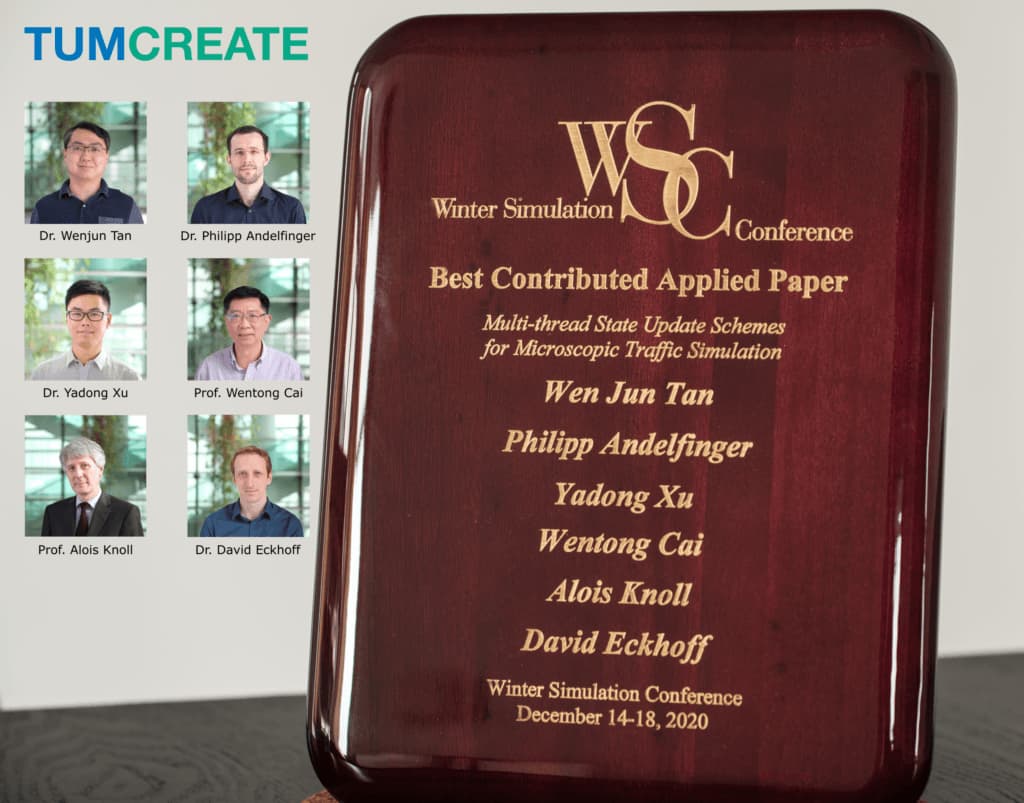
TUMCREATE would like to extend congratulations to our colleagues from the Area-Interlinking Design Analysis group for winning the Best Contributed Application Paper Award at the Winter Simulation Conference (WSC) 2020 with their manuscript titled “Multi-thread State Update Schemes for Microscopic Traffic Simulation”.  The authors are Dr Tan Wen Jun, Dr Philipp Andelfinger, Dr Xu Yadong, Prof Cai Wentong, Prof Alois Knoll, and Dr David Eckhoff.    WSC recognizes contributed papers of exceptionally high quality and implements a stringent process in selecting the winners. Out of 200 accepted contributed papers, four finalists were selected by the track committee. Among the four finalists, the winner was eventually selected by an independent panel of three distinguished members of the simulation community. This academic achievement is a high recognition for the research work by the authors in the simulation field.   The paper discusses how in a simulation (e.g., traffic), agents (e.g., vehicles) are advanced in time such that the reproducibility and scalability of the simulation can be supported. This is a critical aspect to address in high-performance simulations where hundreds of thousands of agents are simulated in parallel. The research has already been incorporated into TUMCREATE’s city-scale simulator CityMoS, which is being deployed in various research, government, and industry projects.   The panel’s decision was based on the following: “This paper systematically explores the effects of different synchronization and agent update methods on the performance of multi-threaded traffic simulations. Asynchronous and synchronous approaches for updating agent states are compared in terms of locking and conflict resolution requirements and simulation runtime. The results of experiments are clearly and succinctly summarised, providing actionable evidence on how best pursuing when applying parallel computing techniques to traffic simulations.”   The Winter Simulation Conference (WSC) is the premier international forum for disseminating recent advances in the field of system simulation, with the principal focus being discrete-event simulation and combined discrete-continuous simulation. In addition to a technical program of unsurpassed scope and quality, WSC provides the central meeting place for simulation practitioners, researchers, and vendors working in all disciplines in industrial, governmental, military, and academic sectors. This year’s theme of WSC is “Simulation Drives Innovation”. Simulation allows us to tackle many complex problems we could not otherwise – which, in turn, allows us to innovate.   The authors’ version of the paper can be found here:  https://www.david-eckhoff.net/pdf/tan2020multi.pdf    

Page Banner

People Behind the Science – Dr Jordan Ivanchev

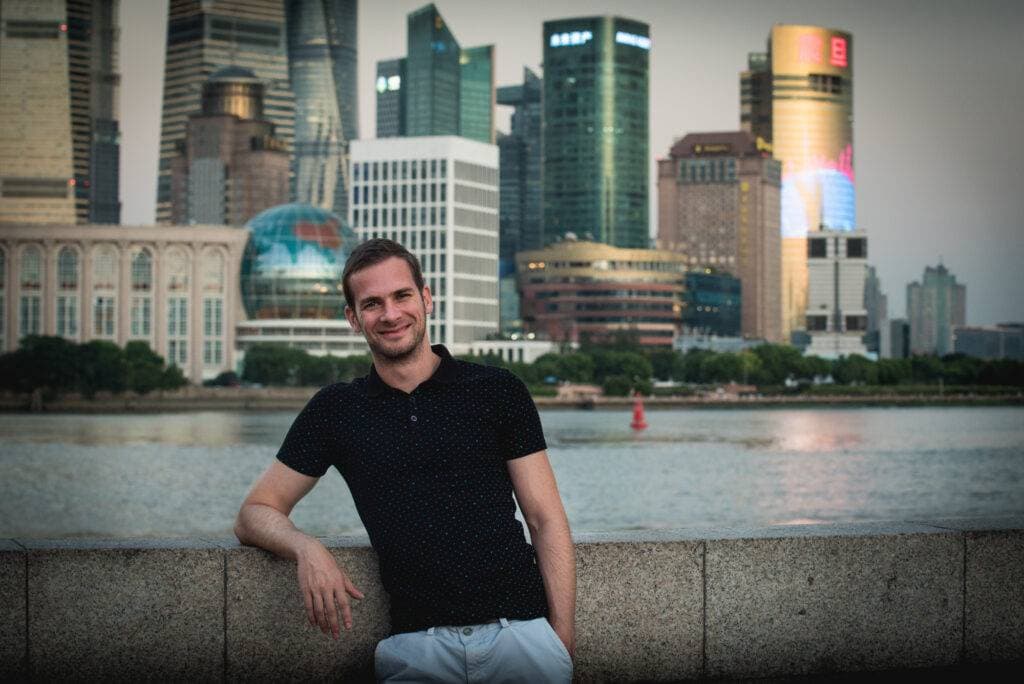
At TUMCREATE, as we prepare to conclude our research in Phase Two – Towards the Ultimate Public Transport System, we would like to highlight our researchers who continue to make significant contributions to the programme. Through our interview series, People behind the Science, we talk to our researchers to discover more about them and their stories.   Dr Jordan Ivanchev, from the team Area-Interlinking Design Analysis (AIDA), joins us in our interview.   Jordan grew up in Bulgaria, a small country in Eastern Europe, where he described as a place filled with rich history, beautiful traditions and warm, kind-hearted people. Besides being active in various sports, Jordan is an airplane enthusiast who gets really excited when it comes to flying, or anything that can fly, be it an airplane or a spaceship. In his free time, he would unwind with a group of friends or sits in front of a piano, playing his favourite tunes.    Q: Tell us about yourself and what you do… I am currently a senior research fellow heading the modelling efforts for our traffic simulator, CityMoS. I have also been part of the Cooling Singapore project, since its beginning in 2016, where I model mobility-related aspects of human behaviour.   I majored in Electrical Engineering and Computer Science for my bachelor’s degree in the Jacobs University in Bremen. After that, I received a master’s degree in Spacecraft Technology and Satellite Communications from the University College London (UCL) and a PhD degree from the Technical University in Munich (TUM).   Q: What made you come to Singapore, and how has it been like living here? I like to say that I came to Singapore because of a lucky misunderstanding. The job advertisement that I applied for only mentioned TUM and I assumed the position was in Munich. At the end of my interview, my interviewer said, “Let me tell you a little bit about Singapore”. I got a little confused and asked why that would be necessary and he simply told me that it was because I would have to live in Singapore. That was when I realized I had to move to Singapore for the job!    Despite my initial shock, I didn’t really hesitate much. I gladly took up the challenge, ready for an adventure, when I was offered the position. I remember vividly that he described Singapore to me as the “Asia for beginners”, which I later found to be quite an accurate description. Living in Singapore has massively enriched my perception of the world. Here, I have met and interacted with people from different cultures, made new friends, worked with great professionals and started a family of my own.   Q: Who or what inspired you to be in your field of research? I have been blessed with a few great teachers along my education path, as early as middle school, that have shaped the way I think, reason and approach and define problems. These individuals, together with my father, have taught me that math is not only a universal tool that can be used to tackle challenges from almost any domain but also a universal language that has the power to seamlessly connect on a very deep conceptual level with people from anywhere in the world. I find it quite romantic that something so abstract, rigorous, and formal can be used to create elegant and intricate solutions for complex problems that reemerge from different academic fields and aspects of life.    I started off my research career in the field of machine learning, which is a small subset of the vast field of mathematical modelling. Although he has quite a peculiar personality, I have to say that Juergen Schmidhuber is one of the most inspirational contemporary thinkers in the field and in artificial intelligence in general. I believe that many other machine learning practitioners of my generation were also attracted to the field by his thoughts, ideas, and his unique way of presenting them.   Q: What are some of the challenges for you in your field of research? As a modeller working at the boundary between product and stakeholders, the biggest challenge has always been to convince the users of the value that comes with the application of our models. I believe that defining model performance metrics is a crucial part of research nowadays and that it is best tackled when both researchers and users work on it together.   Being able to synthesize all information defining the performance of a model into a single number is truly an art that requires a lot of experience and in-depth understanding of both the research field and real world context of the problem, be it financial, social, political, or environmental.   Q: Tell us about your work and journey in TUMCREATE… I joined TUMCREATE in 2013 and am probably one of the people who have been with the company for the longest time! After finishing my doctorate thesis in 2016, I assumed a more versatile role that included being involved in other work on top of my research. I participated in forming collaborations with other entities, initiating new projects and mentoring students. Most of my work revolves around our traffic simulator, CityMoS, where I design models that depict commuter behaviour in different scenarios thus bringing more realism into our simulator and providing better accuracy for decision makers.   In 2017, I also became part of the Cooling Singapore project, providing my expertise in mobility-related modelling. I got a chance to work together with fellow researchers and professors from MIT (Massachusetts Institute of Technology), ETH Zurich (Swiss Federal Institute of Technology in Zurich) and NUS (National University of Singapore). I believe that the project was a great way to do something meaningful for Singapore.   One of the best aspects of working in CREATE is that you are surrounded with people from world-renowned universities. I immensely enjoyed working with Prof. Alberto Sangiovanni-Vincentelli from Berkeley on our common project, BEHAVE, that dealt with studying the

Scroll to Top