
Past Research Group
Individual Mobility Vehicles & Services
The IMVS team, the group of automotive engineers, aims to develop sustainable vehicle concepts for autonomous electric public transportation systems.
Project Details
Status
Completed
Type
Research group
Overview
The IMVS team, the group of automotive engineers, aims to develop sustainable vehicle concepts for autonomous electric public transportation systems. The vehicle concepts are designed to improve energy efficiency, safety, and service quality, while minimizing costs compared to electric buses in the market. The IMVS research focus includes electric powertrain, vehicle user interaction, vehicle packaging, HVAC systems, trajectory optimization for autonomous driving, and autonomous driving impacts on road infrastructure. The team developed the Autonomous Electric Vehicle (AEV) tool, which is the first tool to generate bus concepts with improved visualization and weight estimation. The IMVS’ innovative engineering solutions together with the utilization of full automation allowed for powertrain energy savings up to 13% and cost (per passenger-km) reduction up to 60% compared to those of the conventional buses.
Research
IMVS Work Packages
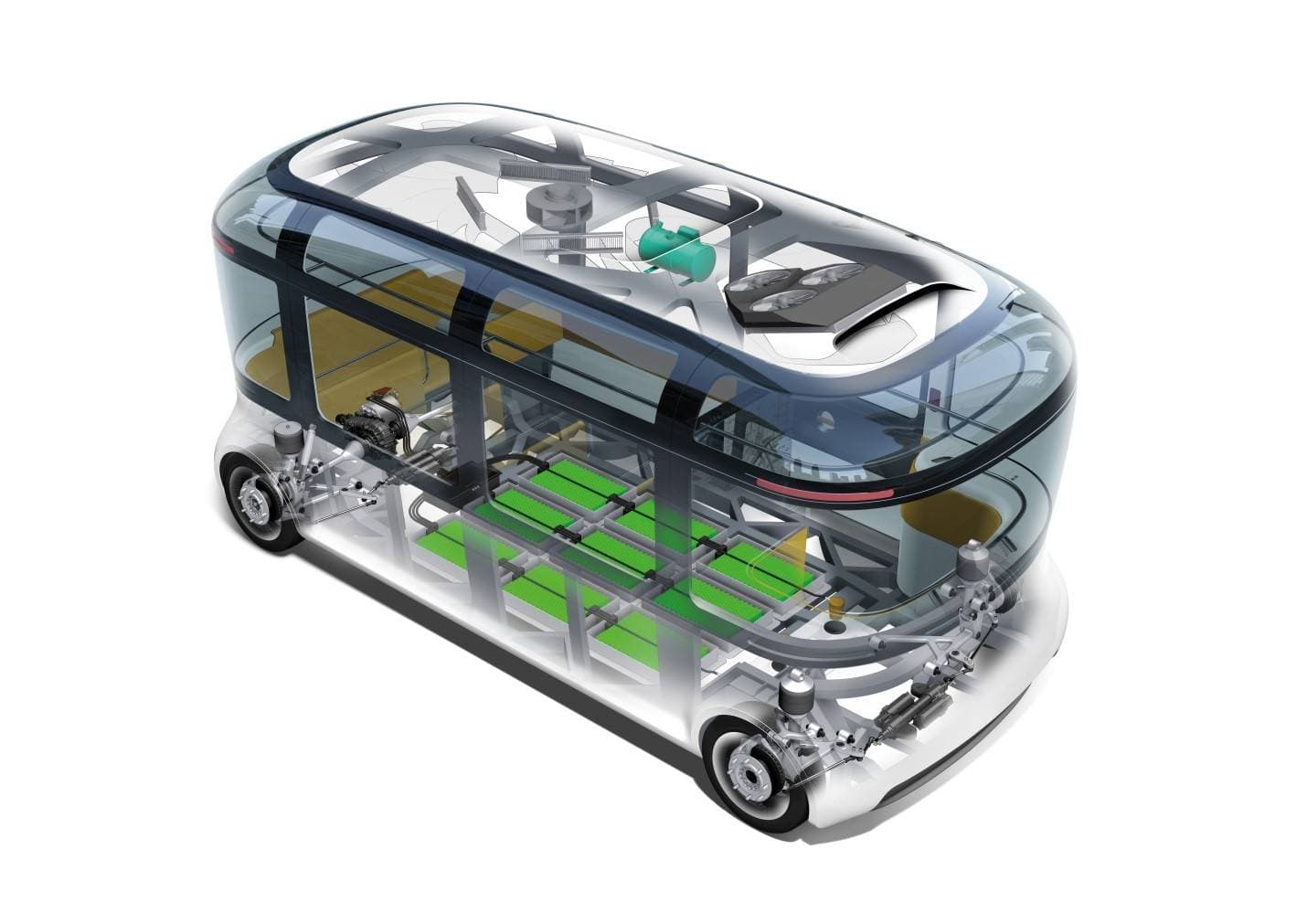
Development of the Autonomous Electric Vehicle (AEV) Tool
The AEV tool, which is a 3D CAD parametric model, allows the engineer to design and develop an appropriate bus concept without the need of using any other program for calculations. The parametric model can size the bus, develop an efficient topology layout, and select the components needed to operate the bus. The CAD model shows a final vehicle concept including the selected topologies and components. The model can develop the vehicle concepts between 4 m and 12 m in length. The AEV tool is able also to provide weight estimation, cost, energy consumption, and environmental emissions.
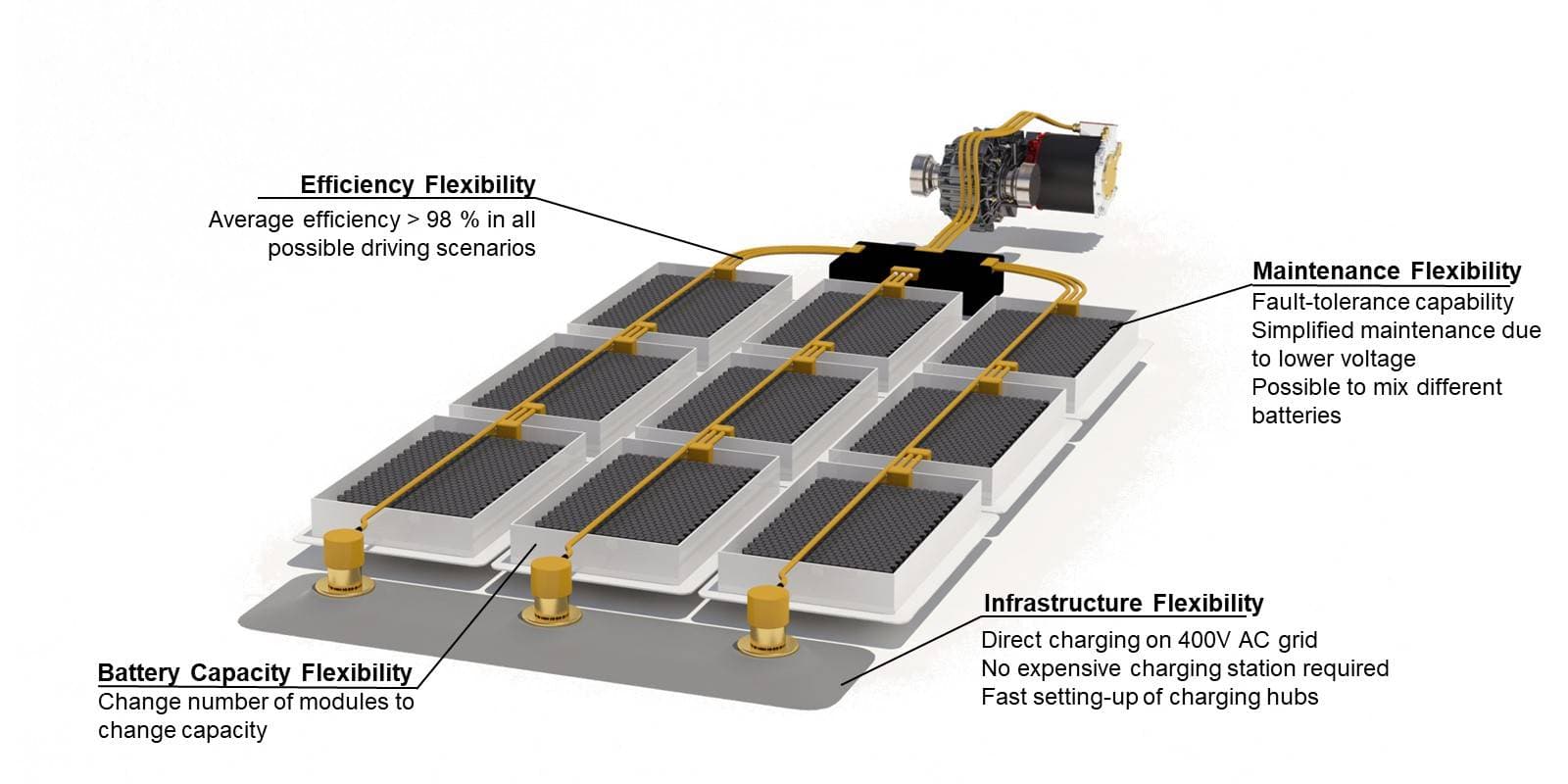
Modular Powertrain Design
The modular powertrain was designed to realize a higher efficiency, a lower total cost of ownership, and a higher energy storage utilization rate compared to conventional electric buses. Additionally, the new architecture is modular for improved maintenance and enables a very simplified second life use case, where each module already has integrated power electronics. Due to the ability to produce and accept 3-phased current, also no expensive charging infrastructure is required, as the battery can directly accept the grid voltage without a conversion.
HVAC System
The HVAC system was developed specifically for tropical climates. It was optimized in order to improve thermal comfort of the passengers while reducing the energy consumption. The work has been conducted in four steps:
- Implementation of air curtains
- Investigation of advanced vapour injection cycle
- Thermal comfort evaluation for passengers using Berkeley Comfort Method
- Air distribution optimization to improve thermal comfort
Vehicle User Interaction
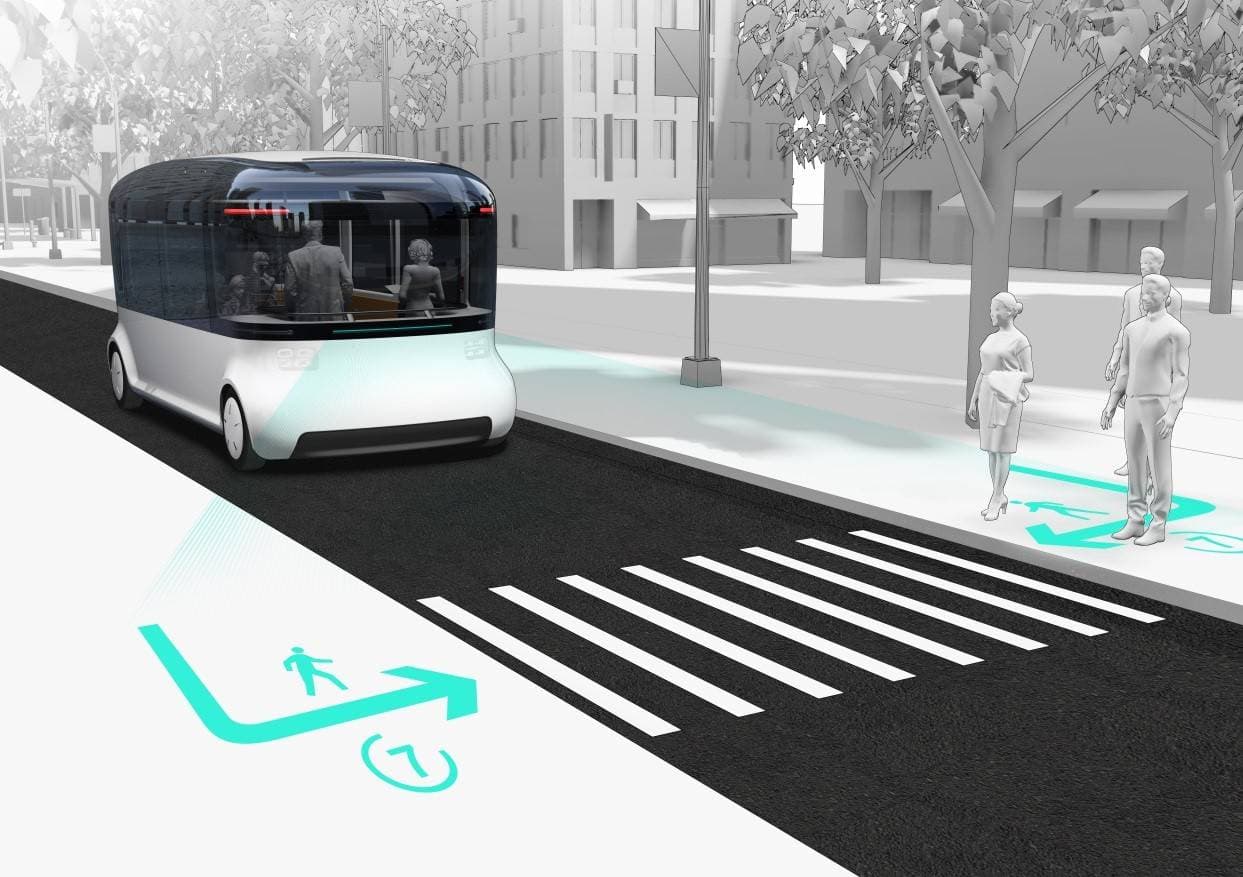
The developed vehicle user interaction system comprises of a projector and sensors. It is able to recognize and track pedestrians in urban settings. For the assessment of technical requirements of the VUI system, first, an easily movable prototype was developed and tested in the field to evaluate its performance under different environmental conditions. The prototype test stand consists of a laser projector and a stereo camera. The camera can detect pedestrians in front of the vehicle using a pre-trained algorithm, while the laser projector allows for the communication between the pedestrian and the vehicle. Based on the field tests using the prototype, technical specifications of the vehicle user interaction system to be utilized in autonomous vehicles were determined.
4 Wheel Independent Steering (4WIS)
4WIS for large autonomous vehicles provides reduced off tracking by allowing decoupled front and rear steering input to realize the optimal path trajectory. This enables in-phase and out-of-phase steering based on the trajectory. In addition, the selection of the trajectory results in improved comfort and safety. The 4WIS was simulated using MATLAB/SIMULINK and ADAMS software to evaluate driving dynamics response and visualization of the optimal path trajectory. The DART vehicle is packaged with the 4WIS along with an independent suspension system. This video explains the operations and advantages of 4WIS together with the independent suspension system.
The IMVS team also develops prototypes, which have been recognized with numerous awards and by local agencies, to solve global transportation related problems. Please refer the following link – https://www.tum-create.edu.sg/research/individual-mobility-vehicles-services#section_project
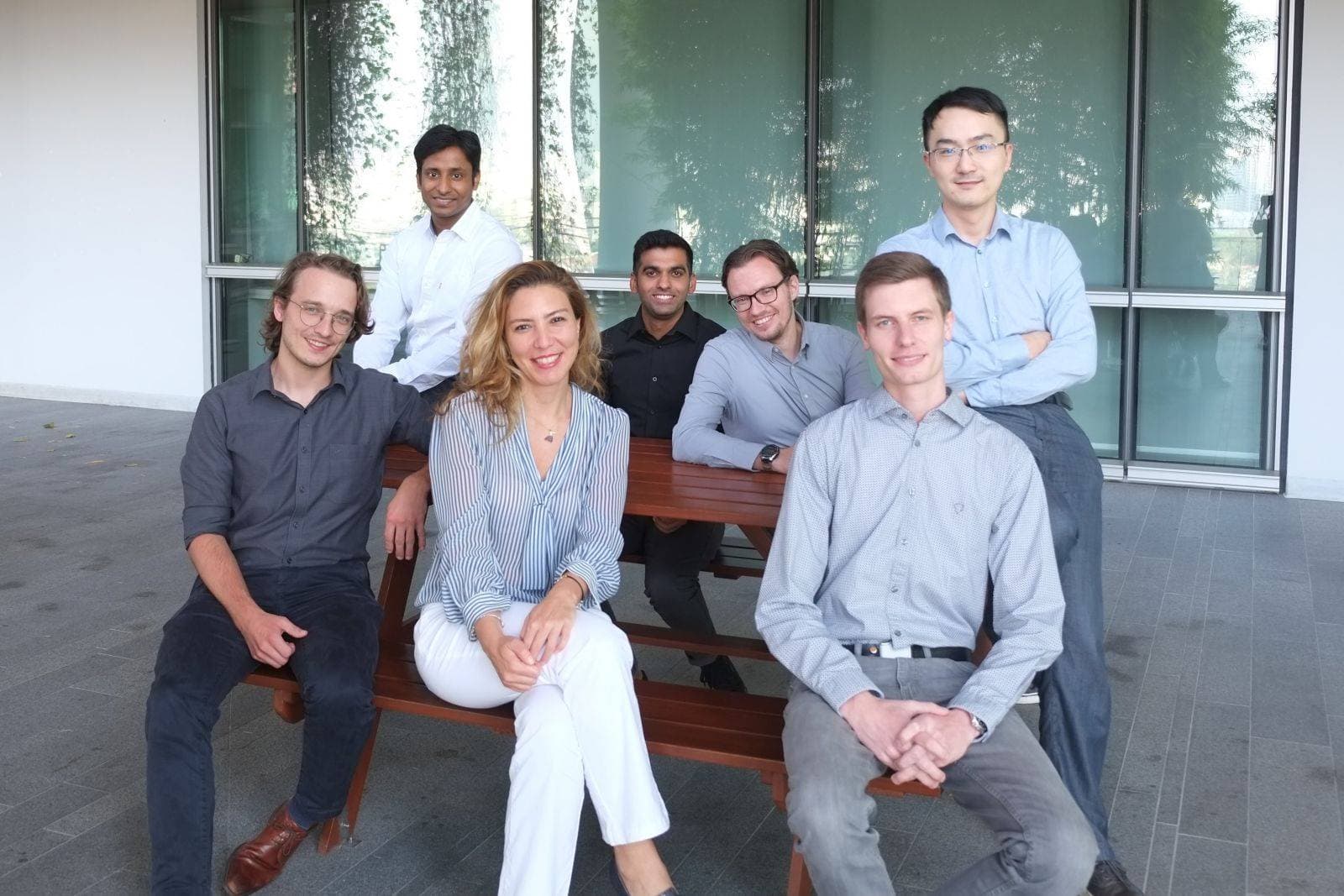
IMVS Team
Related Projects
Publications
- [26] F. Trocker, O. Teichert, M. Gallet, A. Ongel, and M. Lienkamp, “City-scale assessment of stationary energy storage supporting end-station fast charging for different bus-fleet electrification levels”, Journal of Energy Storage, vol. 32, Elsevier, pp. 101794, Dec. 2020, ISSN: 2352-152X, DOI: 10.1016/j.est.2020.101794
- [24] F. Chang, F. Roemer, and M. Lienkamp, “Influence of current ripples in cascaded multilevel topologies on the aging of lithium batteries”, IEEE Transactions on Power Electronics, vol. 35, no. 11, IEEE, pp. 11879–11890, Nov. 2020, ISSN: 1941-0107, DOI: 10.1109/TPEL.2020.2989145
- [22] A. Pathak, G. Sethuraman, A. Ongel, and M. Lienkamp, “Impacts of electrification & automation of public bus transportation on sustainability – A case study in Singapore”, Forschung im Ingenieurwesen, Springer, Jul. 2020, ISSN: 1434-0860, DOI: 10.1007/s10010-020-00408-z
- [21] G. Sethuraman, M. Schwarz, S. Maxl, A. Ongel, M. Lienkamp, H. W. Ng, and P. Raksincharoensak, “Development of an overall vehicle sizing and packaging tool for autonomous electric buses in the early concept phase”, SAE Journal of Commercial Vehicles, vol. 13, no. 1, SAE International, pp. 23–42, Mar. 2020, ISSN: 1946-391X, DOI: 10.4271/02-13-01-0002
- [20] A. Pathak, M. Binder, F. Chang, A. Ongel, and M. Lienkamp, “Analysis of the influence of air curtain on reducing the heat infiltration and costs in urban electric buses”, International Journal of Automotive Technology, vol. 21, no. 1, Springer, pp. 147–157, Feb. 2020, ISSN: 1976-3832, DOI: 10.1007/s12239-020-0015-x
- [18] G. Sethuraman, S. S. R. Ragavareddy, A. Ongel, M. Lienkamp, and P. Raksincharoensak, “Impact assessment of autonomous electric vehicles in public transportation system”, in 2019 IEEE Intelligent Transportation Systems Conference (ITSC), Auckland, New Zealand, IEEE, Oct. 2019, pp. 213–219, DOI: 10.1109/ITSC.2019.8917256
- [17] G. Sethuraman, X. Liu, F. Bachmann, M. Xie, A. Ongel, and F. Busch, “Effects of bus platooning in an urban environment”, in 2019 IEEE Intelligent Transportation Systems Conference (ITSC), Auckland, New Zealand, IEEE, Oct. 2019, pp. 974–980, DOI: 10.1109/ITSC.2019.8917041
- [16] O. Teichert, F. Chang, A. Ongel, and M. Lienkamp, “Joint optimization of vehicle battery pack capacity and charging infrastructure for electrified public bus systems”, IEEE Transactions on Transportation Electrification, vol. 5, no. 3, IEEE, pp. 672–682, Sep. 2019, ISSN: 2332-7782, DOI: 10.1109/TTE.2019.2932700
- [14] A. Pathak, M. Binder, A. Ongel, and H. W. Ng, “Investigation of a multi stage vapour-injection cycle to improve air-conditioning system performance of electric buses”, in Proceedings of the Fourteenth International Conference on Ecological Vehicles and Renewable Energies (EVER), Monaco, Monaco, IEEE, May 2019, pp. 1–7, DOI: 10.1109/EVER.2019.8813517
- [10] F. Chang, O. Ilina, L. Voss, and M. Lienkamp, “Improving the overall efficiency of automotive inverters using a multilevel converter composed of low voltage SI MOSFETs”, IEEE Transactions on Power Electronics, IEEE, pp. 1–17, Jul. 2018, ISSN: 0885-8993, DOI: 10.1109/TPEL.2018.2854756
- [8] F. Chang, R. Khoo, A. Ongel, and M. Lienkamp, “Rapid energy consumption assessment of vehicle concepts for public transport systems without detailed deployment data”, in Proceedings of the International Conference on Innovative Smart Grid Technologies 2018 (ISGT Asia 2018), Singapore, IEEE, May 2018, pp. 1–4, DOI: 10.1109/ISGT-Asia.2018.8467911
- [7] A. Ongel, H. Cornet, P. Kong, R. Khoo, T. Liu, and M. Kloeppel, “Public transport service quality improvement using universal design standards and advanced vehicle technologies”, in Proceedings of the 2018 International Conference on Intelligent Autonomous Systems, Singapore, IEEE, Mar. 2018, pp. 207–212, DOI: 10.1109/ICoIAS.2018.8494057
- [6] B. Jäger, C. Brickwedde, and M. Lienkamp, “Multi-agent simulation of a demand-responsive transit system operated by autonomous vehicles”, in Proceedings of the Transportation Research Board 97th Annual Meeting, Washington, D.C., SAGE, Jan. 2018, pp. 1–15, DOI: 10.1177/0361198118786644
- [5] B. Jäger, F. M. M. Agua, and M. Lienkamp, “Agent-based simulation of a shared, autonomous and electric on-demand mobility solution”, in Proceedings of the 20th IEEE International Conference on Intelligent Transportation (ITSC 2017), Workshop on Modelling, Analysis and Control of Intelligent Mobility-on-demand Systems, Yokohama, IEEE, Oct. 2017, pp. 1–6, DOI: 10.1109/ITSC.2017.8317947
- [4] F. Chang, O. Ilina, O. Hegazi, L. Voss, and M. Lienkamp, “Adopting MOSFET multilevel inverters to improve the partial load efficiency of electric vehicles”, in Proceedings of the 19th European Conference on Power Electronics and Applications, Warsaw, Poland, IEEE, Sep. 2017, pp. 1–13, DOI: 10.23919/EPE17ECCEEurope.2017.8099071
- [3] F. Roemer, M. Lamparter, and M. Lienkamp, “A method for masterless self-assigning CAN bus identifier”, in Proceedings of the 2017 IEEE Transportation Electrification Conference and Expo (ITEC’17), Chicago, IL, IEEE, Jun. 2017, DOI: 10.1109/ITEC.2017.7993257
- [2] B. Jäger, C. Hahn, and M. Lienkamp, “An evolutionary algorithm for an agent-based fleet simulation focused on electric vehicles”, in Proceedings of the 2016 International Conference on Collaboration Technologies and Systems (CTS 2016), Orlando, Florida, USA, IEEE, Nov. 2016, DOI: 10.1109/CTS.2016.0087
- [1] F. Chang and M. Lienkamp, “A modular multilevel topology using power electronic transformers for the modular drivetrains of electric vehicles”, in Proceedings of the 18th European Conference on Power Electronics and Applications, Karlsruhe, Germany, Sep. 2016, pp. 1–9, DOI: 10.1109/EPE.2016.7695543
- [5] S. Krapf, G. Sethuraman, A. Pathak, A. Ongel, and M. Lienkamp, “Improving electric city bus powertrain efficiency and costs using design space exploration”, in Proceedings of the 31st International Electric Vehicle Symposium & Exhibition (EVS31), Kobe, Japan, Oct. 2018, pp. 1–7
- [4] C. Angerer, N. Holjevac, G. Sethuraman, and M. Lienkamp, “AWD for electric vehicles – a revolution for vehicle efficiency?”, in Proceedings of the 31st International Electric Vehicle Symposium & Exhibition (EVS31), Kobe, Japan, Oct. 2018, pp. 1–6
- [3] A. Pathak, R. Khoo, A. Ongel, and M. Lienkamp, “Feasibility of using air curtains in urban buses”, in Proceedings of the 7th Conference on Future Automotive Technology (COFAT ’18), Fürstenfeld, Germany, COFAT, May 2018, pp. 1–13
- [2] M. Kloeppel and M. Lienkamp, “Vehicle concept development for future public transport systems. literature review and methodology”, in Proceedings of the International Conference on Intelligent Transport Systems in Theory and Practice, Munich, Germany, Jul. 2017
- [1] B. Jäger, M. Wittman, and M. Lienkamp, “Agent-based modeling and simulation of electric taxi fleets”, in Proceedings of the 6th Conference on Future Automotive Technology (COFAT ’17), Fürstenfeld, Germany, COFAT, May 2017