
Energy & Smart City
Geothermal-driven Technologies for Passive Enabling of Urban Sustainability Solutions
An Intra-CREATE project mapping Singapore’s geothermal potential and working out what it could realistically be used for.
About the Project
This project is an Intra-CREATE project. The lead institution is Nanyang Technological University, with Lead PI Professor Alessandro Romagnoli. The partner institution is TUMCREATE, with Lead PI Dr Tobias Massier. The Technical University of Munich provided active assistance with its expertise and experience from the Geothermal Alliance Bavaria.
The aim of the project was to provide insights on how best to extract and deploy infrastructure and expertise to harness Singapore’s geothermal potential for urban applications. TUMCREATE’s role was to answer the third of the project’s key questions from a life cycle assessment perspective.
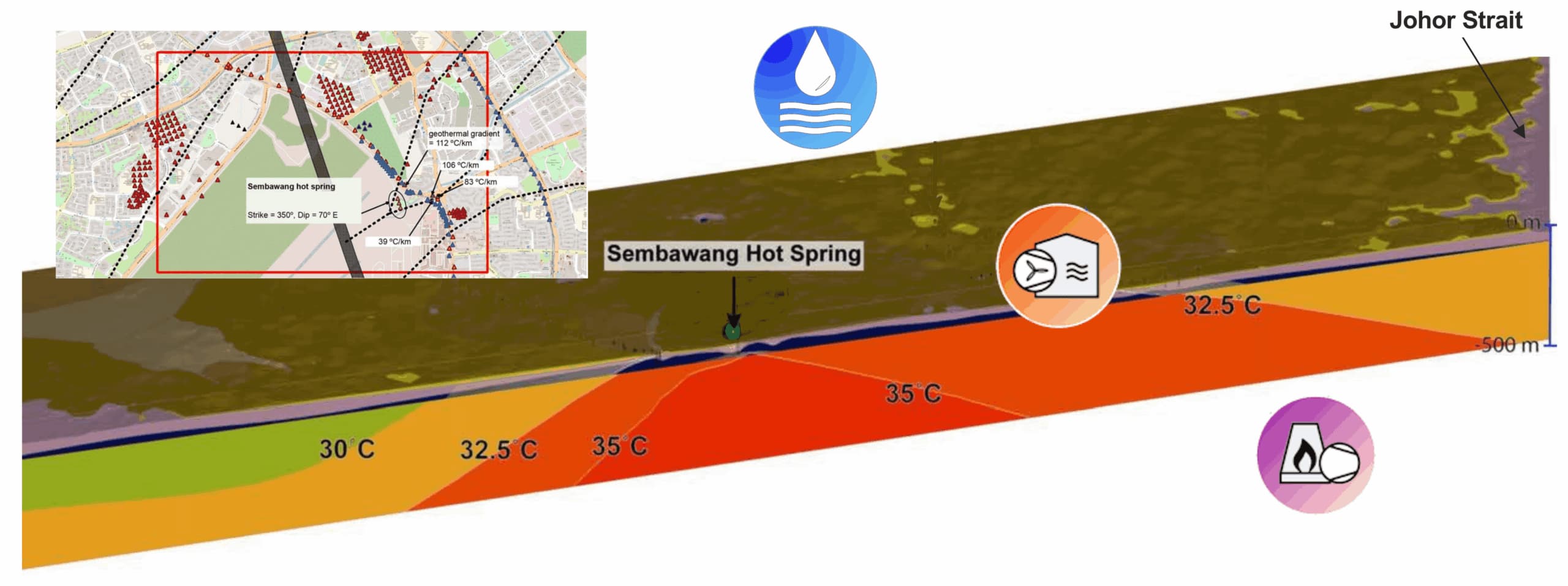
Key Questions
- Where is the available geothermal gradient, and hence what are the temperatures at depth?
- What is the lateral extent of the geothermal gradient?
- What applications can we drive, given the available geothermal resources?
Work Packages
WP1 — Drilling campaign for physical validation of Singapore's geothermal gradient
This work package aimed to physically confirm Singapore’s geothermal gradient through the analysis of granite and groundwater components, shallow and deep borehole drilling, cross-borehole seismic imaging, temperature measurement and laboratory experiments. The data were used to establish and calibrate the numerical model in WP2, and to perform the cost-benefit analysis in WP3.
First the study area was selected and a drilling strategy developed. Temperature profiles in boreholes were then determined and rock properties characterised.
WP2 — Development of numerical models for validation of Singapore's geothermal gradient
This work package aimed to build on and enhance Singapore’s available geothermal model, and to develop an underground virtual laboratory based on the drilling campaign data from WP1 together with existing deep borehole data. The virtual laboratory also serves as the core engine of an underground energy resource platform, which stakeholders from statutory boards, ministries and government agencies can use to visualise the extent of the available geothermal resource, the potential uses of that energy, and the civil engineering work required to extract the heat.
A geothermal model of the study area and a general 3D temperature gradient for Singapore were developed first, followed by the underground virtual laboratory allowing 3D geothermal simulation.
WP3 — Cost-benefit analysis of geothermal energy in Singapore
This work package carried out a cost-benefit study of the techno-economic aspects of both drilling and heat exploitation, drawing on the outcomes of WP1 and WP2. The results of the drilling campaign and the simulation studies made it possible to understand how much heat is available, and the extent and depth at which it can be extracted. On that basis a techno-economic analysis was carried out to understand the costs, challenges and opportunities associated with geothermal energy extraction.
The techno-economic analysis was combined with an environmental analysis using life cycle assessment, carried out by TUMCREATE. The applications considered were district cooling (for example of data centres or estates), district heating, desalination of sea water, and power generation.